

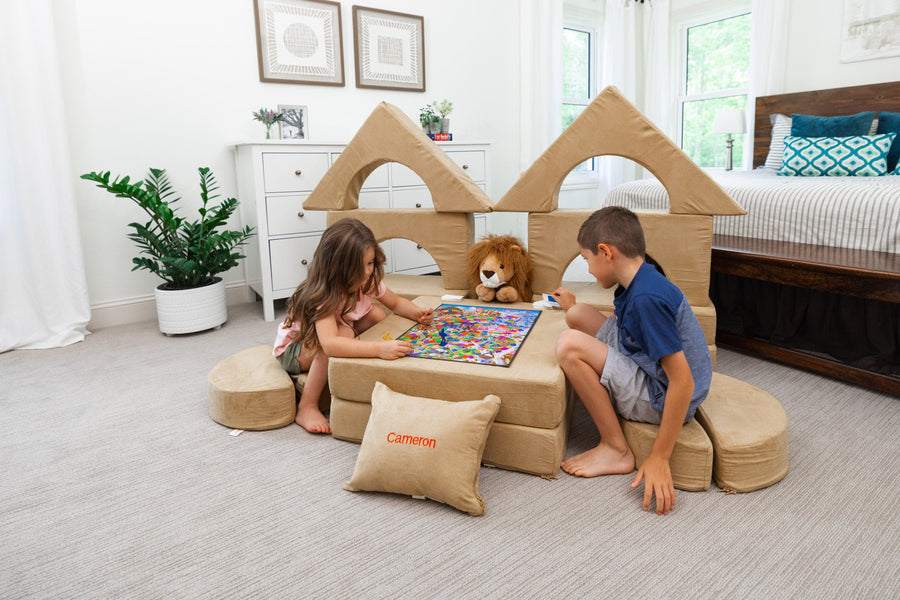


Open ended toys, like blocks, art supplies, pretend play sets and modular foam pieces, have no single right way to play, so children decide what happens next. Closed-ended toys, like puzzles and shape sorters, have one correct outcome. Both support development. Open-ended toys build imagination and problem-solving, closed-ended toys build focus and follow-through, and most children benefit from a mix.
Walk down any toy aisle and nearly every box makes the same promise: this toy will help your child learn. Some of them keep that promise. But the toys children come back to month after month usually have one thing in common. They leave plenty of room for the child's own ideas.
Most toys fall into one of two groups. Closed-ended toys have a clear goal and a finish line. Open-ended toys have neither, so your child decides what happens next. In this guide we look at how the two differ, what research says about play, which open-ended toys suit each age, and how to set up a play space at home with a healthy mix of both.
What are open-ended toys?
An open-ended toy has no single right way to use it. There are no instructions and no moment when the toy tells your child the game is over. A pile of blocks can be a tower in the morning, a zoo by lunchtime and a road for toy trucks after dinner. The blocks never change. The ideas your child brings to them do.
Because they are simple, open-ended toys tend to grow with a child. A one-year-old holds a soft block and studies it. A two-year-old stacks it. A five-year-old turns it into part of a fort with a door, a window and a very strict password policy.
Familiar examples include:
-
Building blocks in all sizes
-
Art supplies such as crayons, paper and modeling dough
-
Pretend play items like play food, dress-up clothes and dolls
-
Loose parts such as scarves, cups and cardboard boxes
-
Modular play furniture made of foam pieces that can be moved and rebuilt
What are closed-ended toys?
Closed-ended toys are built around a goal. A puzzle is done when every piece is in place. A shape sorter is done when every shape has found its slot. A matching game ends when the last pair is turned over.
That clear finish line is exactly what makes them useful. Children practice following steps, sticking with a task when it gets tricky, and checking their own work. And when the last puzzle piece clicks into place, they know they did it themselves. Those small moments of "I finished!" do a lot for a young child's confidence.
Open-ended vs closed-ended toys at a glance
| Compare | Open-ended toys | Closed-ended toys |
|---|---|---|
| How play works | Child-led, with no fixed outcome | Goal-led, with one correct outcome |
| Examples | Blocks, art supplies, pretend play sets, modular foam play castles | Puzzles, shape sorters, matching games, kits with instructions |
| Skills they support | Imagination, flexible thinking, problem-solving, and gross motor skills with climbing toys | Focus, following directions, persistence, fine motor skills |
| When play ends | When your child decides it is over | When the task is complete |
| How long they stay useful | Often several years, because the play changes as your child grows | Often a shorter window, until the task becomes easy |
| Worth knowing | Some children need a little help getting started | Can lose their appeal once mastered |
What research says about play
In 2018 the American Academy of Pediatrics published a clinical report called The Power of Play, which reviewed a large body of research on how young children play and why it matters. The report makes the case that pediatricians should take play seriously, because play is one of the main ways young children learn.
According to the report, play supports:
-
Executive function. These are the skills children use to plan, focus, remember instructions and switch between tasks.
-
Language and early math skills
-
Social skills, such as taking turns and working through disagreements
-
Coping with stress
The report puts special weight on play that children lead themselves, choosing what to do and how to do it. That is the kind of play open-ended toys invite. With no instructions to follow, your child has to decide what to build, test whether it stands up, and try again when it does not.
None of this makes closed-ended toys less valuable. It simply explains why so many pediatricians and early educators encourage families to leave plenty of time for free, child-directed play.
Open-ended toys by age

The best open-ended toys stay useful as your child's abilities change. Here is roughly how play develops in the early years, and what tends to work well at each stage. Always check the manufacturer's age guidance, and supervise during play, especially with any toy your child climbs on.
Open-ended toys for 1-year-olds
At this age play is all about exploring. Your little one is working out how things move, stack, roll and fall, and what happens when they push, pull or drop them. Soft blocks, stacking cups, balls and low foam pieces to crawl over and pull up on all work beautifully. There is nothing to get "wrong," so your child can simply experiment and build coordination along the way.
Open-ended toys for 2-year-olds
Somewhere around two, imagination starts to show up. A box becomes a car and a block becomes a phone. Big building blocks, simple pretend play items, chunky crayons and large foam shapes for climbing are all great choices. You will also see early problem-solving, like figuring out why a tower keeps tipping and what to do about it.
Open-ended toys for 3-year-olds
By three, play becomes more independent and full of stories. Children invent characters, give each other roles and happily stay with one game for longer stretches. Building blocks, dress-up clothes, pretend play sets and soft climbing pieces for simple obstacle courses are ideal. This is also a lovely age for puzzles and matching games, which give children a calmer, focused kind of play to balance all that invention.
Open-ended toys for 4-year-olds and up
Older kids keep the same toys and simply get more ambitious with them. Forts grow extra rooms. Obstacle courses stretch across the living room. Games come with rules the children made up themselves and will defend with great seriousness. Toys with enough pieces to build big, and a few new shapes to work with, keep this age engaged.
Where closed-ended toys still fit
Puzzles, board games and building kits with instructions are not the enemy of creativity. They teach children to follow steps, work toward a goal and see a task through to the end. Children lean on those skills every day once school starts.
What matters is balance. A play space with only closed-ended toys can feel like a list of tasks to finish. A play space with only open-ended toys can leave some children unsure where to begin. A mix of both gives your child room to invent and chances to practice focus and follow-through.
Why open-ended toys tend to last longer
Many parents come to love open-ended toys for a very practical reason: they do not get outgrown in a season. A toddler might crawl across a set of foam pieces. A few years later, the same child uses those pieces to build a castle with a drawbridge. The toy stays the same while the play keeps growing.
Children also come back to them more often. Because there is no single right way to play, the same materials can feel new again and again. When you think about cost per year of use, rather than the price on the box, a well-made open-ended toy often turns out to be one of the better investments in the playroom.
A real-life example: modular foam play castles

Modular foam play furniture is a good example of an open-ended toy that grows with a child. Here is how it works with the castles we make at FoamOh.
The Original Play Castle Sofa comes with 14 buildable pieces plus 1 personalizable pillow: half-moons, arches, triangle wedges, squares and rectangles. There are no instructions in the box. The pieces stack into a sofa for movie night, spread out into a fort, and turn into something completely different by the next morning.
The FoamOh Super Castle Play Sofa includes everything in the 14-piece castle, plus a Triangle Ramp, a Steps piece and a Circle, for 17 buildable pieces plus 1 pillow. The extra shapes open up slides, taller builds and longer obstacle courses, which older builders especially enjoy. If you already own a castle, the Ramp, Steps and Circle are also sold on their own in our accessories collection.
A few details parents often ask about:
-
Ages: designed for ages 1 and up, for climbing, building and imaginative play. Not for sleeping. Always supervise children during play.
-
Foam: furniture-grade foam (1.5 lb density, 40 ILD) that is CertiPUR-US® certified and made without flame-retardant chemicals.
-
Covers: removable microsuede covers you can put in the washing machine. See our care guide for washing tips.
-
Where they are made: made in the USA and assembled in Milan, Tennessee.
If you need ideas, our castle builds page has real builds from FoamOh families and free build guides to download. You can compare both castles in the castles collection. If a castle is on your holiday gift list, every castle comes with a pillow that can be personalized with your child's name, and you can pick their favorite shade on our colors page.
How to encourage more open-ended play at home
You do not need a picture-perfect playroom or a mountain of toys. A few small changes make a real difference.
Put fewer toys out at once. In a 2018 study, researchers watched toddlers play in a room with either 4 or 16 toys. With fewer toys, the children played longer with each one and found more ways to use it. Rotating a handful of toys every week or two keeps things feeling fresh without buying anything new.
Create a "yes" space. Children play more freely in a spot where building, climbing and making a mess are allowed. A clear patch of floor with a few soft pieces is plenty.
Keep materials easy to reach. When children can see and grab their toys, they are much more likely to start playing on their own.
Let a little boredom happen. When you do not hand over an activity right away, children often invent one. Resist the urge to jump in too quickly.
Join in, then step back. Build the base of a fort together, then let your child take it from there. You set the scene and they write the story.
So, which is better?
Both. Open-ended toys give children room to imagine, invent and solve problems their own way, and they tend to stay in use for years. Closed-ended toys build focus, patience and that wonderful feeling of finishing something. The happiest play spaces usually include both kinds, with plenty of time for children to lead.
If you are choosing where to invest, look for open-ended toys that grow with your child. Then add a few well-loved puzzles and games for the quieter moments.
Frequently asked questions
What is the main difference between open-ended and closed-ended toys?
Open-ended toys let your child decide how to play, so the same blocks can be a castle today and a road tomorrow. Closed-ended toys have one right outcome, like a finished puzzle or a sorted set of shapes. Both are valuable, but open-ended toys tend to hold a child's interest over a longer period.
Do children need both kinds of toys?
Yes. Closed-ended toys help children practice focus, following directions and finishing a task. Open-ended toys support imagination and flexible thinking. A mix of both lets your child enjoy calm, focused play and freer, more creative play depending on the day and their mood.
At what age can children start playing with open-ended toys?
Young children can enjoy simple open-ended toys like soft blocks and stacking cups as soon as they start exploring objects with their hands, so always check each toy's age guidance. FoamOh castles are designed for ages 1 and up, for climbing, building and imaginative play. They are not designed for sleeping. Always supervise children during play.
How do I get my toddler interested in open-ended play?
Start small and keep it simple. Build something basic together, like a low tunnel or a tower of blocks, then step back and see what your toddler does with it. Keep just a few toys out at a time, rotate them regularly, and try not to fill every quiet moment with a new activity.
Are open-ended toys worth a higher price?
Often, yes, if they are well made. Because open-ended toys stay useful across several years and many kinds of play, the cost per year of use can be lower than a cheaper toy that is outgrown in a few months. Look for durable materials, washable covers and pieces that work together in many different ways.
Can a closed-ended toy be used in open-ended ways?
Sometimes. A shape sorter might become a drum or a treasure box, and puzzle pieces can turn into pretend food or letters in a post office game. Watching how your child bends the rules of a toy is a good sign that their imagination is at work.
My child prefers screens. How can I encourage more hands-on play?
Set up a small play area with two or three open-ended toys and no devices nearby. Try a short building challenge together, like making a bridge for a toy car, then gradually let your child take over. Hands-on play often wins once children discover they are the ones in charge of what happens.
How much space do I need for open-ended play?
Less than you might think. A clear area about the size of a play rug works well for most families, and you can expand for bigger builds on weekends. FoamOh castle pieces stack back into a sofa shape when playtime is over, so the play space doubles as seating in the living room.
Do open-ended toys make good holiday gifts?
They make some of the most lasting gifts, because a child can play with them in new ways for years rather than weeks. Look for something that suits your child's age now and can grow with them. A personal touch, like a pillow with their name on it, makes the gift feel like it truly belongs to them.
Curious what other parents think?
Read real FoamOh! parent reviews →