



CertiPUR-US® certified means the flexible polyurethane foam inside a product has been tested by independent, accredited laboratories and meets the program's standards for content, emissions and durability. It covers the foam only, not the fabric, zippers or finished product, and certified foam is retested every year to keep its certification.
If you have been shopping for a kids couch, a mattress or any foam furniture lately, you have probably seen the CertiPUR-US® seal. Some brands put it front and center. Others tuck it into the fine print. Either way, it is worth knowing what it actually tells you, and what it does not, because the foam inside a kids couch is something your child will climb on, build with and lounge on every single day.
Here is a clear, parent-friendly guide to what the certification means, how to check a brand's claim, and how it compares with other labels you might see.
What is CertiPUR-US®?
In short: an independent certification program for flexible polyurethane foam, administered by a nonprofit organization.
CertiPUR-US® certifies the flexible polyurethane foam used in products like mattresses, upholstered furniture, pillows and kids couches. Foam producers apply for certification, and their foam is analyzed by independent, accredited testing laboratories against the program's published Technical Guidelines.
In other words, the foam maker does not get to grade its own homework. According to CertiPUR-US, the program's standards were developed with input from the foam, mattress and furniture industries, along with an advisory panel of scientists, academics, environmentalists and consumer group representatives.
Is it a government certification? No. CertiPUR-US is a voluntary program run by a nonprofit, not a government agency. That does not make it less useful. It simply means it is one of several independent programs brands can choose to take part in.
What CertiPUR-US® certified foam is tested for
In short: certified foam is made without certain harmful substances and meets limits for indoor air emissions.
According to CertiPUR-US, certified foam is:
| What is checked | What it means | The standard |
|---|---|---|
| Formaldehyde | A chemical some foams could release into the air | Made without formaldehyde |
| Ozone depleters | Chemicals that damage the ozone layer | Made without ozone depleters |
| Phthalates | Chemicals used to soften some plastics | Made without prohibited phthalates (those regulated by the U.S. Consumer Product Safety Commission) |
| Heavy metals | Metals such as mercury and lead | Made without mercury, lead and other heavy metals |
| VOC emissions | Volatile organic compounds, gases that can be released into indoor air | Low emission, with VOCs below 0.5 parts per million |
| Flame retardants and other chemicals of concern | Chemicals classified as carcinogens, mutagens or reproductive toxins | Screened for relevant chemicals, including flame retardants, classified as harmful to human health |
| Durability | How well the foam performs over time | Meets the program's durability standards |
Criteria as published by CertiPUR-US, checked 30 September 2026.
A note on VOCs: new foam can have a mild smell when it is first unboxed. Certification does not promise there will be no smell at all. It does mean the foam's emissions were tested against a specific indoor air quality limit.
How often certified foam is tested
In short: twice in the first year, then every year, plus random spot checks.
Certification is not a one-time stamp. According to CertiPUR-US, certified foams are:
-
Tested and analyzed twice in the first year
-
Recertified annually after that
-
Subject to random verification testing, with program representatives collecting foam samples from participating plants and testing them at the program's expense
For parents, that ongoing testing is part of what makes the seal meaningful. A certification that is checked every year says more than a claim made once at launch.
What CertiPUR-US® covers and what it does not
In short: it tells you about the foam inside the cushion, not everything about the finished product.
This is the part that often gets misunderstood. CertiPUR-US applies to the flexible polyurethane foam only. It is not a safety certification for an entire couch, mattress or toy.
Covered by CertiPUR-US®
- The flexible polyurethane foam inside the product
- Specific content criteria (formaldehyde, heavy metals, phthalates and more)
- VOC emissions from the foam
- Durability of the foam
Not covered by CertiPUR-US®
- Cover fabrics and textile dyes
- Zippers, seams and stitching
- Waterproof or stain-resistant treatments on fabrics
- The overall design, stability or safety of the finished product
- Age suitability or how a product should be used
A simple way to think about it: CertiPUR-US tells you what is inside the cushion. For everything else, look at the rest of the product information: the cover materials, the construction, the recommended ages and the brand's own safety guidance.
CertiPUR-US® vs OEKO-TEX® vs GREENGUARD
In short: each label looks at a different part of a product, so they complement each other.
You may see other certifications alongside CertiPUR-US. Here is how the most common ones differ:
| Certification | What it covers | What to know |
|---|---|---|
| CertiPUR-US® | Flexible polyurethane foam | Content, emissions and durability criteria for the foam only |
| OEKO-TEX® Standard 100 | Textiles, such as fabrics and threads | Tests fabrics for certain harmful substances |
| GREENGUARD Gold | Finished products and materials | Focuses on low chemical emissions into indoor air, with stricter limits designed with children and other sensitive groups in mind |
No single label answers every question. When a brand is clear about which certifications apply to which parts of a product, that is a good sign.
How to check a CertiPUR-US® claim yourself
In short: find the foam producer's listing on the CertiPUR-US website.
One of the best things about this certification is that you do not have to take a brand's word for it. You can:
-
Ask the brand who makes its foam.
-
Look up that foam producer in the CertiPUR-US list of certified foam producers.
-
Open the producer's listing to see its certificate and which foam families are certified.
You can also check the directory of companies selling products with certified foam, which CertiPUR-US updates weekly.
If a company cannot tell you who makes its foam, or cannot explain its certification, that is worth noticing.
How FoamOh's foam measures up

In short: FoamOh castles use CertiPUR-US® certified foam, and you can check the supplier listing yourself.
The foam in FoamOh castles comes from HLJ Foam Products, which appears on the CertiPUR-US list of certified foam producers. You can see HLJ Foam's CertiPUR-US listing and certificate directly on the program's website.
Beyond the certification, here is what goes into both of our castles:
-
Furniture-grade foam: 1.5 lb density and a 40 ILD rating, so pieces keep their shape through years of climbing and building
-
Made without flame-retardant chemicals
-
Removable microsuede covers that you can machine wash (see our care guide)
-
Made in the USA, assembled in Milan, Tennessee
-
Designed for ages 1 and up, for climbing, building and imaginative play. Not for sleeping. Always supervise children during play.
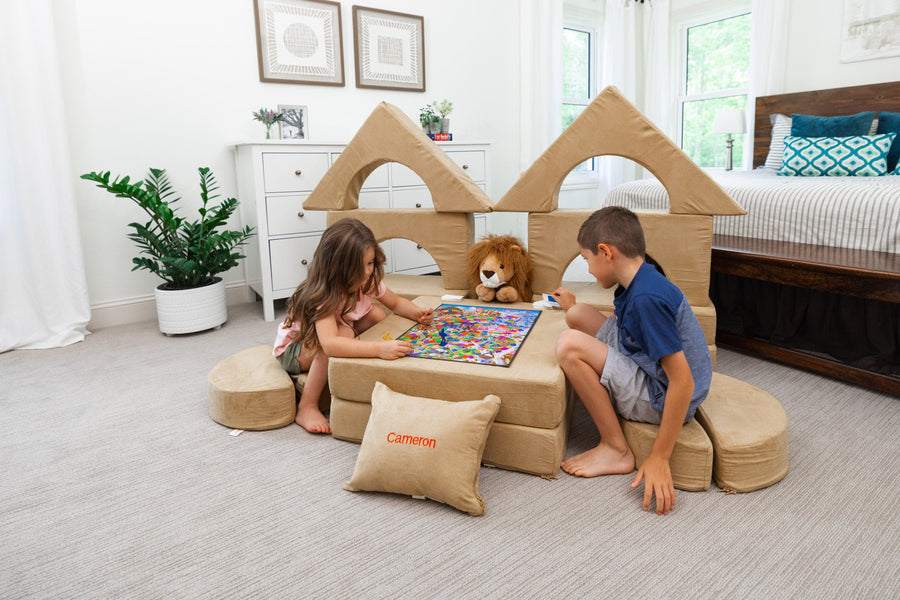
The Original Play Castle Sofa comes with 14 buildable pieces plus a personalizable pillow, and the FoamOh Super Castle Play Sofa has 17 buildable pieces plus a pillow. You can compare both in our castles collection.
If you are shopping for a holiday gift and want to double-check materials before you buy, our FAQ covers the questions parents ask most, and our team is always happy to help.
What makes a brand trustworthy on materials
In short: it names its certifications, explains its materials and makes its claims easy to verify.
"Non-toxic" gets used a lot, and it does not have one official definition. A more useful way to judge a brand is to ask whether it:
-
Names specific certifications, rather than vague words like "safe" or "natural"
-
Explains which parts of the product each certification covers
-
Tells you who makes its foam, so you can check the listing yourself
-
Answers questions openly about materials, sourcing and care
The bottom line

CertiPUR-US® certified means the foam inside a product has been independently tested and meets published standards for content, emissions and durability, and it is retested every year. It is one of the most widely recognized foam certifications, and it is easy to verify. Just remember that it covers the foam only, so look at the whole product, including the covers, construction and recommended ages, before you decide.
When your child is building forts, climbing mountains or curling up with a favorite book after a long afternoon of play, knowing a little more about what is inside those cushions is a pretty good feeling.
Frequently asked questions
What does CertiPUR-US certified mean?
It means the flexible polyurethane foam in a product has been analyzed by independent, accredited laboratories and meets CertiPUR-US standards for content, emissions and durability. Certified foam is made without formaldehyde, ozone depleters, prohibited phthalates, mercury, lead and other heavy metals, and has VOC emissions below 0.5 parts per million.
Does CertiPUR-US certify the whole product?
No. CertiPUR-US applies only to the flexible polyurethane foam inside a product. It does not cover the fabric, dyes, zippers, stitching or the overall safety and design of the finished product.
Is CertiPUR-US a government certification?
No. CertiPUR-US is a voluntary certification program administered by a nonprofit organization. Foam is tested by independent, accredited laboratories against the program's published Technical Guidelines.
How often is CertiPUR-US foam tested?
According to CertiPUR-US, certified foams are tested and analyzed twice in the first year and recertified every year after that. Certified foams are also subject to random verification testing.
Is CertiPUR-US certified foam safe for toddlers?
CertiPUR-US certification tells you the foam meets specific standards for content, emissions and durability, which many parents find reassuring. It does not cover the rest of the product, so also check the covers, construction and the manufacturer's recommended ages. FoamOh castles, for example, are designed for ages 1 and up and are not for sleeping. Always supervise young children during play.
What is the difference between CertiPUR-US, OEKO-TEX and GREENGUARD?
CertiPUR-US certifies flexible polyurethane foam. OEKO-TEX Standard 100 tests textiles such as fabrics for certain harmful substances. GREENGUARD Gold focuses on low chemical emissions from finished products and materials. Each label covers a different part of a product.
How can I check if a brand's foam is CertiPUR-US certified?
Ask the brand who makes its foam, then look up that foam producer in the CertiPUR-US list of certified foam producers on certipur.us. Each listing shows the producer's certificate and which foam families are certified.
Is FoamOh foam CertiPUR-US certified?
Yes. FoamOh castles use foam from HLJ Foam Products, which is listed as a certified foam producer on the CertiPUR-US website. Our foam is furniture-grade, with a 1.5 lb density and a 40 ILD rating, and is made without flame-retardant chemicals.