



Foam climbing blocks for toddlers are made mainly for climbing, balancing and crawling. A modular play couch does those things too, and also turns into forts, pretend-play worlds and everyday seating. Climbing blocks suit young toddlers who mostly want to climb. A play couch suits families who want one set to grow with their child over several years.
If you are setting up an indoor play space, you have probably found yourself comparing these two. Both get kids moving, both are soft, and both can keep a toddler busy on a rainy afternoon. They are built for slightly different jobs, though, and the right choice depends on your child's age, how they like to play and how much space you have.
A quick note before we start: we make modular foam castles at FoamOh, so we are not a neutral party. We have tried to lay out the differences fairly so you can choose what fits your family.
What are foam climbing blocks for toddlers?

In short: sets of foam shapes designed mainly for climbing, crawling and balancing.
Foam climbing blocks usually come as a set of shapes: wedges, ramps, steps, arches, cylinders and platforms. Some are inspired by the Pikler approach, with arches and triangles for early climbers. Others are simple geometric soft-play sets.
Their main job is gross motor play: climbing up, crawling through, sliding down and balancing across. For toddlers who are just learning to climb, that focus is exactly what they need. According to the CDC's 18-month milestones, most children can climb on and off a couch or chair without help by around 18 months, and many are practicing well before that.
What climbing blocks do well:
-
Shapes designed specifically for climbing and crawling
-
Often simple and low, which suits young toddlers
-
Easy to set up as a small climbing course
Where they can fall short:
-
They are mostly for physical play, with less built-in support for forts or pretend play
-
Most do not work as seating
-
As children get older and more confident, some sets may feel less challenging
What does a modular play couch offer?
In short: climbing and crawling, plus forts, pretend play and a place to sit.
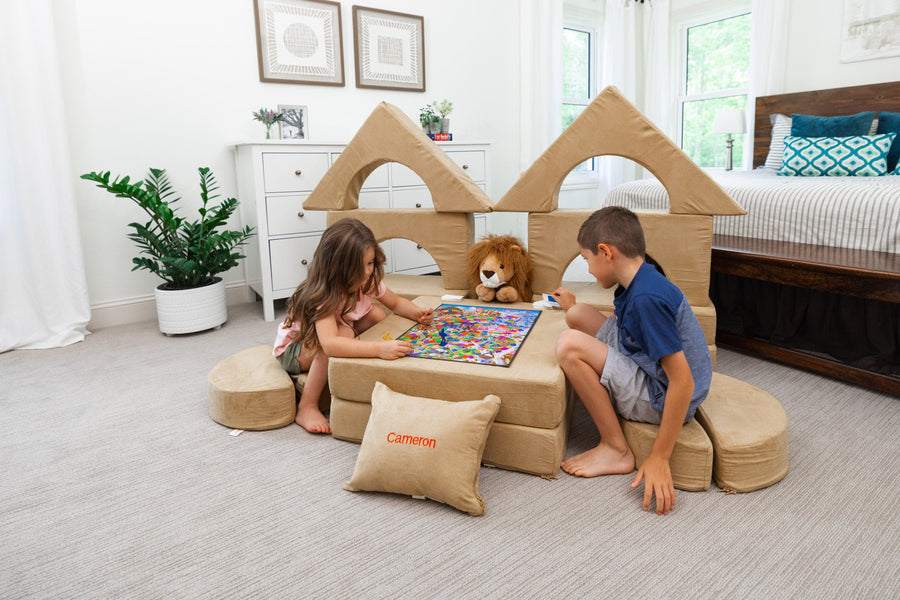
A modular play couch is made of foam pieces that stack into a sofa and come apart for building. Children can climb it, slide down it and crawl through it, just like climbing blocks. They can also build castles, forts, shops and reading nooks, and at the end of the day the pieces go back together as a couch for movie night.
That mix of physical play, pretend play and everyday furniture is the biggest difference. Around the age of two, many children start using objects to pretend, so a foam arch becomes a cave or a boat. A play couch can move into that stage with them.
The American Academy of Pediatrics report The Power of Play describes both active physical play and imaginative, child-led play as valuable for young children. A play couch simply makes room for both in one set.
Play couch vs climbing blocks: side by side
| Foam climbing blocks | Modular play couchFoamOh castles | |
|---|---|---|
| Main purpose | Climbing, crawling, balancing | Climbing, building, pretend play and seating |
| Typical pieces | Wedges, ramps, steps, arches, cylinders | 14 buildable pieces + 1 pillow, or 17 + 1 with the Triangle Ramp, Steps and Circle |
| Climbing and crawling | Designed for it | Supported with low builds, ramps and tunnels |
| Forts and pretend play | Limited, depending on the set | Designed for it |
| Works as seating | Usually not | Yes, stacks into a sofa |
| Recommended ages | Varies by brand, so check the manufacturer | Ages 1 and up. Not for sleeping. |
| Price | Varies widely by brand and size | $254 (14 pieces) or $379 (17 pieces) |
| Foam certification | Varies by brand | CertiPUR-US® certified |
| Covers | Varies by brand | Removable, machine-washable microsuede |
| Best for | Toddlers focused on climbing, smaller budgets or small spaces | Families wanting one set for climbing, building and lounging over several years |
FoamOh prices are standard retail prices as of 30 September 2026. Climbing block details vary by brand, so check specific products before you buy.
Which works best at each age?
Every child is different, so treat these as general patterns rather than rules. Always check each product's recommended ages, and supervise during play.
Around 1 to 2 years
In short: both can work, and simple, low shapes are what matter most.
Young toddlers are crawling, pulling up, cruising along the furniture and taking their early steps. Low, simple shapes are ideal. A small climbing set is purpose-built for this. A play couch works well too, with its pieces laid low for crawling over, pulling up on and early climbing. At this age, keep everything low and always supervise.
Around 2 to 3 years
In short: climbing is still the main event, and pretend play starts to join in.
Toddlers are climbing with more confidence and starting to pretend. Climbing blocks keep meeting that physical need. A play couch meets it too, and adds tunnels, forts and "houses" that toddlers love to crawl into and name.
Around 3 to 5 years
In short: this is where building and pretend play often take over.
Preschoolers tell longer stories, build bigger forts and play for longer stretches. A play couch gives them lots of material to build with. Climbing blocks can still be part of the fun, especially in obstacle courses, but many children start using them less on their own.
Around 5 years and up
In short: older kids tend to want bigger builds and a comfy spot to hang out.
Big kids plan ambitious forts and obstacle courses, and a play couch also becomes a place to read, watch movies and hang out with friends. Climbing blocks can still add variety to builds, especially ramps and steps.
Which one is best for your family?
Foam climbing blocks may be the better fit if:
-
Your child is a young toddler who mainly wants to climb
-
You have limited space and want something small and low
-
You already have seating and just want a climbing corner
A modular play couch may be the better fit if:
-
You want one set that grows from climbing to forts to lounging
-
Your child loves pretend play, or you expect them to soon
-
You want something that also works as kids' seating
-
You have siblings who like to build together
Both may make sense if:
-
You want dedicated climbing shapes for a young toddler, plus a couch that carries on into the preschool years
How FoamOh castles work as climbing blocks

In short: our castle pieces make low climbs, tunnels and slides, and our add-ons are built for climbing.
The Original Play Castle Sofa has 14 buildable pieces plus a personalizable pillow: 4 half-moons, 2 arches, 2 triangle wedges, 2 squares and 4 rectangles. Wedges and squares make low climbing mountains, arches make crawl-through tunnels, and half-moons make gentle bumps and bridges.
For more climbing, our three add-ons work like foam climbing blocks for toddlers and fit with every castle:
-
Triangle Ramp: prop it up as a slide or lay it flat as a ramp to climb
-
Steps: 10 inches high on one side and 5 on the other, for climbing practice at two heights
-
Circle: adds curves for rolling, balancing and new builds
The FoamOh Super Castle Play Sofa includes all three, for 17 buildable pieces plus a pillow. If you already have a castle, you can add them one at a time from our accessories collection.
Both castles use furniture-grade, CertiPUR-US® certified foam (1.5 lb density, 40 ILD) made without flame-retardant chemicals, with removable, machine-washable covers. They are designed for ages 1 and up, for climbing, building and imaginative play. Not for sleeping. Always supervise children during play.
To see how families use the pieces for climbing, obstacle courses and forts, browse our castle builds page, or compare both castles in the castles collection.
Safety and space tips for either option
-
Check the recommended ages for any climbing set or play couch before you buy
-
Keep builds low for younger toddlers, and add height as their skills grow
-
Use a non-slip rug or mat underneath
-
Leave clear space around the play area, away from windows and hard furniture edges
-
Check the foam and covers. Look for certified foam and covers that come off for washing
-
Always supervise during climbing and active play
Final thoughts
There is no single winner here. Foam climbing blocks are a great choice for young toddlers who mostly want to climb. A modular play couch covers climbing too, then carries on into forts, pretend play and cozy seating as your child grows. Think about your child's age, how they love to play and how much space you have, and you will find the right fit. And if you are shopping for the holidays, either one makes a gift that gets used every single day.
Frequently asked questions
What are foam climbing blocks for toddlers?
Foam climbing blocks for toddlers are soft foam shapes, such as wedges, ramps, steps and arches, designed mainly for climbing, crawling and balancing. They give young children a soft, low place to practice gross motor skills indoors.
Is a play couch better than climbing blocks?
It depends on what you need. Climbing blocks are designed mainly for climbing and suit young toddlers well. A modular play couch also supports climbing, and adds fort building, pretend play and seating, so many families find it stays useful for longer.
Can a play couch be used for climbing?
Yes. A modular play couch with sturdy, supportive foam can be arranged into low climbing mountains, ramps and crawl-through tunnels. FoamOh also makes a Triangle Ramp, Steps and Circle that add extra climbing options to any castle.
What age are foam climbing blocks for?
It varies by brand, so check the manufacturer's recommended ages. Many families use climbing shapes with young toddlers who are learning to crawl, pull up and climb. FoamOh castles and add-ons are designed for ages 1 and up, for climbing, building and imaginative play, and are not for sleeping.
What are good indoor climbing toys for 3-year-olds?
At three, children often enjoy both climbing and pretend play. Foam climbing blocks, a modular play couch, or a mix of both can work well. Look for sturdy, certified foam, shapes that can be rearranged, and builds you can make more challenging over time.
Do play couches help with gross motor development?
A play couch gives children lots of chances to climb, crawl, slide, balance and carry pieces, all of which use large muscle groups. Like any play equipment, it works best as part of plenty of active play throughout the day.
Can I use climbing blocks and a play couch together?
Yes. Many families combine climbing shapes with a play couch to make bigger obstacle courses and forts. FoamOh's Ramp, Steps and Circle are designed to work with both FoamOh castles.