

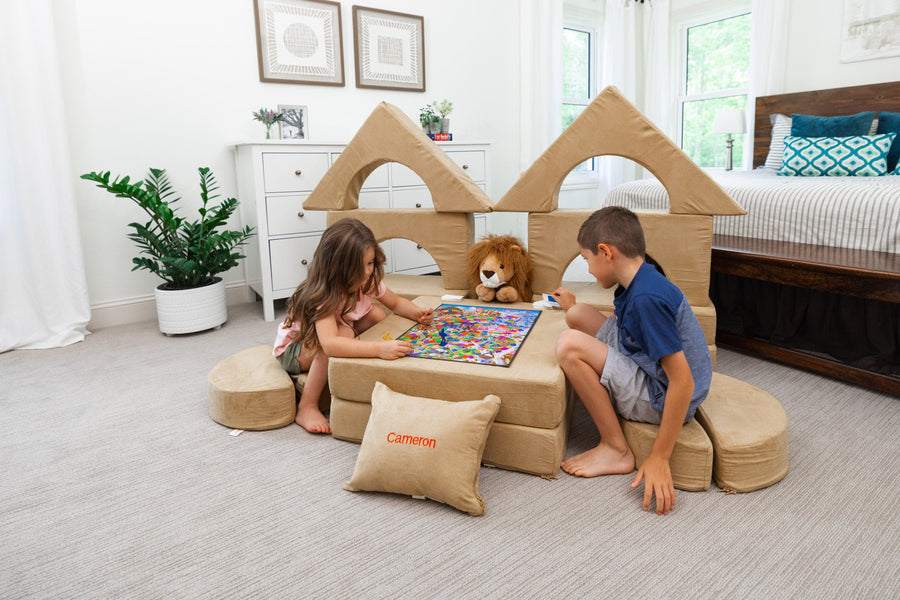


Physical play is any play where children use their whole body: climbing, crawling, running, balancing, jumping and carrying. It helps build strength, coordination and body awareness, and gives children a healthy outlet for their energy. The World Health Organization recommends at least 180 minutes of physical activity a day for children aged 1 to 4.
When we talk about child development, the focus often lands on reading, letters and educational toys. Those things matter. But some of the most important learning in early childhood does not happen at a table. It happens when a child is climbing over couch cushions, crawling through a fort, wobbling along a homemade balance path or running laps around the living room pretending to be a dinosaur.
This guide covers what physical play is, why it matters, how much children need, what tends to get in the way, and how to make room for more of it at home, even without a playroom.
What is physical play?

In short: any play where children move their bodies to explore, test and figure out the world.
Physical play includes climbing, crawling, rolling, running, dancing, balancing and jumping. It also includes what occupational therapists call "heavy work": dragging a big box across the room, carrying a stack of cushions, or pushing pieces into place to build a fort.
For adults, exercise is usually something planned. For young children, movement is spontaneous. They do not climb to get fit. They climb because they are curious, because it feels good, and because moving is one of the main ways they learn.
Physical play is also different from organized sports and classes. Soccer and dance lessons are wonderful as children grow, but in free play, children choose their own challenges, test their own limits and recover from wobbles at their own pace.
Why physical play matters
In short: it builds strength, coordination and confidence, and it supports other areas of development too.
It builds the body
Every climb, crawl and jump works large muscle groups and helps children develop balance, coordination and strength. Children also learn how their bodies move through space: how high to lift a foot to step over something, how to shift their weight to stay balanced, and where their body ends and the coffee table begins.
It supports thinking and problem-solving
Physical play is full of small problems to solve. How do I get up there? Will this tower hold if I climb on it? What if I try the other side? The American Academy of Pediatrics report The Power of Play describes play, including active, child-led play, as important for children's development, including executive function skills like planning, focusing and adjusting when something does not work.
It gives feelings somewhere to go
Most parents have watched a grumpy toddler transform after a few minutes of running around. Active play gives children a healthy outlet for big energy and big feelings, and many families find their children are calmer and more settled after a good stretch of movement.
It builds confidence
When a child finally climbs to the top of the mountain they built, or crosses a balance path without stepping in the "lava," you can see the pride on their face. Those small wins add up to a child who is more willing to try new things.
How much physical activity do young children need?
In short: the WHO recommends at least 180 minutes a day for children aged 1 to 4, spread throughout the day.
The World Health Organization's guidelines for children under 5 recommend:
| Age | Physical activity | Screen time |
|---|---|---|
| Under 1 year | Active several times a day, especially through interactive floor-based play. For babies not yet moving around, at least 30 minutes of tummy time spread through the day while awake | Not recommended |
| 1 to 2 years | At least 180 minutes of varied physical activity at any intensity, spread throughout the day | Not recommended for 1-year-olds. No more than 1 hour for 2-year-olds, and less is better |
| 3 to 4 years | At least 180 minutes of varied physical activity, including at least 60 minutes of moderate to vigorous activity | No more than 1 hour, and less is better |
Source: World Health Organization. Checked 30 September 2026.
The WHO also recommends that young children are not restrained for more than 1 hour at a time, for example in strollers or high chairs. Three hours of activity sounds like a lot, but it does not mean three hours of structured exercise. It means lots of short bursts of climbing, dancing, crawling and chasing, which most toddlers are very happy to provide when they have the space.
How physical play changes as children grow

In short: the movements get bigger and more complex, and imagination joins in along the way.
Every child develops at their own pace. Here is a broad picture, with a few milestones from the CDC's developmental milestones:
-
Babies (under 1): tummy time, rolling, reaching and crawling, usually on a play mat or blanket on the floor. By 1 year, most babies can pull up to stand and walk while holding on to furniture.
-
Young toddlers (1 to 2): cruising, early steps and plenty of climbing. By 18 months, most children can climb on and off a couch or chair without help.
-
Older toddlers (2 to 3): running, kicking a ball, climbing everything in sight.
-
Preschoolers (3 to 5): movement and imagination merge. Children climb because they are escaping lava or scaling a castle wall. By 5, most children can hop on one foot.
-
Kids 5 and up: bigger challenges, games with rules, obstacle courses they design and time themselves.
Looking for specific ideas by age? See our guide to gross motor activities for toddlers.
Why physical play has become harder for many kids
In short: modern homes and routines often make sitting easier than moving.
Many families face real constraints. Winter weather, busy schedules, small apartments and limited outdoor space can all make active play harder. Many living rooms are also set up mainly for sitting and watching, so movement becomes something children have to be redirected away from rather than invited into.
This is not about blaming parents or technology. It simply means that making physical play easy, especially indoors, can make a real difference to how much of it happens.
How to make space for physical play at home
In short: clear floor space, something soft to climb, somewhere to crawl and permission to move.
You do not need to turn your home into a gym. A few simple features go a long way:
-
Open floor space. Even a temporary patch, cleared for playtime, gives children room to move.
-
A soft surface. Foam pieces, a thick rug or padded mats make climbing and tumbling more comfortable.
-
Something to climb. It just needs to be stable, low enough for your child's skills, suitable for their age and safe to fall from.
-
Somewhere to crawl. Tunnels, forts and small enclosed spaces invite a different kind of movement.
-
Permission to move. A space where climbing and building are welcome, instead of constantly redirected.
Easy indoor physical play ideas
-
Obstacle course: climb, crawl, balance and jump, then change one station every few days
-
Balance path: a winding line of flat cushions or pieces across the floor
-
Tunnel crawl: arches or chairs draped with a blanket
-
Freeze dance: dance until the music stops, then freeze in a funny shape
-
Fort building: carrying, lifting and stacking pieces is excellent heavy work
-
Animal moves: hop like a frog, crawl like a bear, waddle like a penguin
Children often do not notice they are exercising, because they are too busy playing.
Challenge versus danger
In short: children benefit from manageable challenges, with a grown-up nearby.
It is natural to want to protect our children from every bump. But play that is a little challenging, like climbing a bit higher or balancing along a narrow path, is how children learn what their bodies can do and how to judge risk for themselves.
The goal is not to remove every challenge. It is to create a space where challenges are the right size, falls land somewhere soft, and a grown-up is close by. Keep builds low for younger children, let height grow with their skills, and always supervise during active play.
Free play, sports and screens
In short: all three can have a place, but free physical play is hard to replace.
-
Organized sports are great as children get older. In free play, though, children set their own goals and rules, which builds creativity and independence alongside physical skills.
-
"Active" screen games can be more engaging than passive viewing, but they cannot fully replace real climbing, crawling, carrying and balancing in a physical space.
-
Screens after play are a different experience from screens instead of play. A movie after an afternoon of fort building is a very different day from a whole afternoon on the sofa.
How FoamOh castles support physical play

In short: soft, sturdy pieces that become climbing mountains, tunnels, ramps and forts, and then stack back into a sofa.
Our castles are designed for exactly this kind of everyday movement. The Original Play Castle Sofa comes with 14 buildable pieces plus a personalizable pillow: half-moons, arches, triangle wedges, squares and rectangles. Stack them into a low climbing mountain, line up the arches for a tunnel or lay rectangles out as a balance path.
For extra climbing, our add-ons work as foam climbing pieces:
-
Triangle Ramp for slides and inclines
-
Steps, 10 inches high on one side and 5 on the other, for climbing practice at two heights
-
Circle for curves, rolling and balancing
The FoamOh Super Castle Play Sofa includes all three, for 17 buildable pieces plus a pillow. You can also add them to any castle from our accessories collection.
Both castles use furniture-grade, CertiPUR-US® certified foam (1.5 lb density, 40 ILD) made without flame-retardant chemicals, with removable, machine-washable covers. They are designed for ages 1 and up, for climbing, building and imaginative play. Not for sleeping. Always supervise children during play. For build ideas, visit our castle builds page, or compare both castles in our castles collection.
A quick physical play checklist
Take a look around your home and ask:
-
Is there clear floor space where your child can move freely?
-
Is there something safe to climb and a soft place to land?
-
Does your child get unstructured movement time every day?
-
Are there chances to crawl, balance and carry things?
-
Are screens off during active play time?
-
Is outdoor play part of most days, when the weather allows?
You do not need to tick every box. Just notice where a little more movement could fit into your day.
Movement is how children learn
Physical play is not a break from learning. For young children, it is one of the main ways they learn about their bodies, their world and what they are capable of. Give them a little space, something soft to climb and the freedom to move, and they will take it from there, even on the coldest winter days.
Frequently asked questions
What is physical play for children?
Physical play is any play that uses the whole body, such as climbing, crawling, running, rolling, balancing, dancing, jumping and carrying. It is usually child-led and unstructured, which makes it different from organized sports or classes.
Why is physical play important for toddlers?
Physical play helps toddlers build strength, balance and coordination, learn how their bodies move through space, and practice solving small problems. It also gives them a healthy outlet for energy and big feelings, and helps build confidence.
How much physical activity do toddlers need each day?
The World Health Organization recommends that children aged 1 to 4 get at least 180 minutes of physical activity a day, spread throughout the day. For 3- and 4-year-olds, at least 60 minutes of that should be moderate to vigorous. Babies under 1 should be active several times a day, including at least 30 minutes of tummy time for those not yet moving around.
What are good indoor physical activities for preschoolers?
Obstacle courses, balance paths, tunnel crawls, freeze dance, animal moves and fort building all work well indoors. Soft foam pieces make it easy to set these up and change them every few days.
Does physical play help brain development?
The American Academy of Pediatrics describes play, including active, child-led play, as important for young children's development, including skills like planning and focusing. Physical play also gives children lots of chances to solve problems and try again when something does not work.
At what age should physical play start?
Physical play starts in babyhood. The World Health Organization recommends that babies be active several times a day, especially through floor-based play, including at least 30 minutes of tummy time a day for babies who are not yet moving around. For babies, a play mat or blanket on the floor works well. Always supervise babies during tummy time and floor play.
What is the best indoor equipment for physical play?
Look for a mix of safe climbing surfaces, soft landings, spaces to crawl through and gentle inclines, suited to your child's age. Modular foam pieces can provide all of these in one set and can be rearranged as your child grows. FoamOh castles are designed for ages 1 and up and are not for sleeping.