

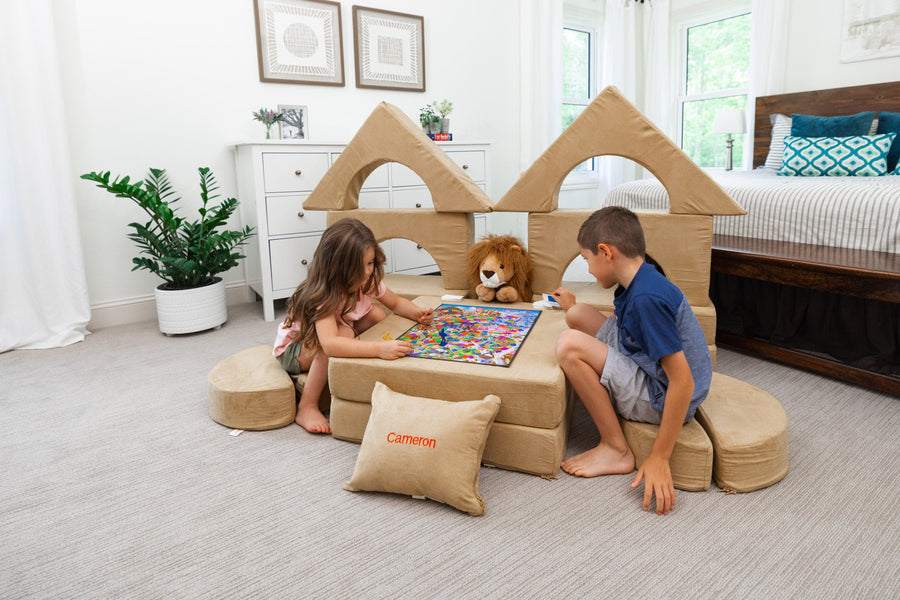


Gross motor activities for toddlers are games that use the big muscles in the arms, legs and core: climbing, crawling, balancing, jumping and carrying. At home, soft foam pieces make it easy to set up climbing mountains, crawl-through tunnels, balance paths and small obstacle courses that change every day and grow with your child.
If you have a toddler, you already know that sitting still is not really their thing. They climb onto the sofa, crawl under the table, carry cushions across the room and jump off the bottom stair with enormous pride. All that movement is not random. It is how young children build strength, balance and coordination, one wobbly attempt at a time.
The good news is that you do not need a gym or a big backyard to support it. Here are simple gross motor activities for toddlers you can set up indoors, what each one helps with, and how to change them as your child grows.
What are gross motor skills?
In short: skills that use the large muscles of the body, like crawling, walking, climbing, running and jumping.
Gross motor skills involve the big muscle groups in the arms, legs and trunk. They include things like:
-
Rolling, crawling and pulling up to stand
-
Walking, running and climbing
-
Balancing on one foot or along a line
-
Jumping, hopping and kicking a ball
-
Lifting, pushing and carrying heavier objects
Fine motor skills, by contrast, use the small muscles in the hands and fingers, for things like picking up a raisin or holding a crayon. Both matter, but gross motor play is where toddlers really burn off energy.
Gross motor milestones by age
In short: every child develops at their own pace, but there are common milestones to look out for.
The CDC's developmental milestones list what most children can do by a certain age. Here are some of the movement milestones:
| By this age | Most children can… |
|---|---|
| 1 year | Pull up to stand and walk while holding on to furniture |
| 18 months | Walk without holding on, and climb on and off a couch or chair without help |
| 2 years | Kick a ball, run, and walk (not climb) up a few stairs with or without help |
| 4 years | Catch a large ball most of the time |
| 5 years | Hop on one foot |
Source: CDC, Learn the Signs. Act Early., checked 30 September 2026. If you have questions about your child's development, talk to your child's doctor.
Children reach these milestones at different times, and that is normal. If you ever have questions about your child's development, your pediatrician is the best person to talk to.
How much active play do toddlers need?

In short: the WHO recommends at least 180 minutes of physical activity a day for children aged 1 to 4, spread throughout the day.
According to World Health Organization guidelines, children aged 1 to 2 should spend at least 180 minutes a day in a variety of physical activities at any intensity. For children aged 3 to 4, that is at least 180 minutes, with at least 60 minutes at moderate to vigorous intensity. The key phrase is "spread throughout the day." That does not mean three hours of structured exercise. It means lots of short bursts of climbing, crawling, dancing and running around, which toddlers are usually very happy to provide.
On cold or rainy days, when outdoor play is harder, having a few indoor gross motor activities ready makes those 180 minutes much easier to reach.
8 gross motor activities for toddlers
In short: soft, rearrangeable pieces let you set up a different movement challenge every day.
Each activity below uses a few foam pieces. We have included the FoamOh castle pieces we use, but cushions, pillows and sturdy boxes work too. FoamOh castles are designed for ages 1 and up, and they are not for sleeping. Always supervise children during active play, and keep builds low for younger toddlers.
1. Climb the mountain
Stack two or three pieces into a low, wide mountain with a gentle slope on one side. Your toddler climbs up, sits on top, and slides or climbs back down. This builds leg and arm strength, coordination and confidence. Start with one layer, and add height only as their climbing gets steadier.
2. Crawl-through tunnel
Line up arches in a row to make a tunnel, and drape a blanket over the top for a darker, cozier version. Crawling through tight spaces works the shoulders, core and hips, and helps toddlers learn how their body fits through spaces.
3. Balance path
Lay rectangles and squares flat in a winding line and invite your toddler to walk along it without stepping "in the lava." Holding their hand at first is fine. Balance paths help with balance, coordination and body control.
4. Stepping stones
Space pieces a small step apart so your child has to step, or later jump, from one to the next. It is a simple game that practices balance, leg strength and planning where to put their feet.
5. Ramp slide
Prop a wedge or the Triangle Ramp against a low piece to make a gentle slide. Toddlers climb up, slide down, and repeat roughly a hundred times. It is great for core strength, climbing and bravery.
6. Carry and build
Let your toddler carry pieces across the room to build a fort wherever they like. Carrying, pushing and lifting is what occupational therapists call "heavy work." The OT Toolbox, run by pediatric occupational therapist Colleen Beck, explains how this kind of proprioceptive play supports body awareness, meaning a child's sense of where their body is and how it moves. It also gives toddlers a lovely sense of independence.
7. Low jump-down
Place one flat, low piece in front of a soft landing spot. Your child steps up, then jumps down onto the landing. Jumping builds leg strength, balance and coordination. Keep the height low, and make sure the landing area is clear.
8. Mini obstacle course
Put a few of the ideas above together: climb the mountain, crawl through the tunnel, walk the balance path and finish with a jump. Obstacle courses practice many skills at once, plus remembering steps in order. Change one station every few days to keep it fresh.
For more ideas from real families, browse our castle builds page, where you can also download free build guides.
Movement, skill and build at a glance
In short: match the movement you want to practice with a simple build.
| Movement | Skill it builds | Castle build to try | Pieces to use |
|---|---|---|---|
| Climbing | Strength in arms and legs, coordination | A low mountain with a gentle slope | Squares, triangle wedges |
| Crawling | Shoulder, core and hip strength, body awareness | A crawl-through tunnel | Arches, plus a blanket |
| Balancing | Balance, body control | A winding "lava" path | Rectangles and squares laid flat |
| Stepping | Balance, planning foot placement | Stepping stones a small step apart | Squares and half-moons |
| Sliding | Core strength, confidence | A gentle slide | Triangle wedge or Triangle Ramp |
| Carrying | Strength, body awareness, independence | "Build a fort wherever you like" | Any lightweight pieces |
| Jumping | Leg strength, coordination | A low step with a soft landing | One flat square or the Steps piece, plus a rectangle landing |
| Sequencing | Several skills at once, remembering steps | A mini obstacle course | A mix of all of the above |
These are general play ideas. Every child is different. Always supervise children during play.
Why open-ended movement is so valuable
In short: when there is no single right way to play, children move in more varied ways.
Many toys guide children toward one specific action. Open-ended setups work differently. A pile of soft pieces can become a climbing wall, a tunnel and a balance beam in the same afternoon, so children naturally climb, crawl, balance and jump all in one play session.
The American Academy of Pediatrics report The Power of Play highlights the value of active, child-led play for young children's development. A soft play setup does not make toddlers hit milestones faster. It gives them lots of safe, repeatable chances to practice the movements they are already working on.
How to set up a movement-friendly space at home
In short: clear floor space, soft pieces, low challenges and a grown-up nearby.
You do not need to redesign your home. A few thoughtful choices go a long way:
-
Clear a patch of floor away from windows, hard furniture edges and anything that could tip over
-
Use a rug or mat that does not slide
-
Keep challenges low for younger toddlers, and let height grow with their skills
-
Change one thing every few days so the space keeps feeling new
-
Stay close by and always supervise during active play
A space that is an obstacle course in the morning can become a quiet reading nook by the afternoon, simply by moving a few pieces.
Where FoamOh castles fit in
In short: modular foam castles give toddlers a soft, sturdy set of shapes to climb, crawl and build with.
Our castles were designed for exactly this kind of play. The Original Play Castle Sofa comes with 14 buildable pieces plus a personalizable pillow: half-moons, arches, triangle wedges, squares and rectangles. The FoamOh Super Castle Play Sofa adds a Triangle Ramp, a Steps piece and a Circle, for 17 buildable pieces plus a pillow. You can also add those three pieces to any castle from our accessories collection.
Both castles use furniture-grade, CertiPUR-US® certified foam (1.5 lb density, 40 ILD) made without flame-retardant chemicals, with removable, machine-washable microsuede covers. They are designed for ages 1 and up, for climbing, building and imaginative play. Not for sleeping. Always supervise children during play. When playtime is over, the pieces stack back into a sofa. Compare both in our castles collection.
If you are looking for a holiday gift that will keep a toddler moving through the long winter months, a set of soft pieces they can climb, build and rearrange is one they are likely to use every day.

Final thoughts
Gross motor development happens in small, everyday moments: a confident climb, a wobbly walk along a balance path, a proud jump onto a soft landing. With a clear space, a few soft pieces and a grown-up cheering nearby, your home can offer plenty of chances to practice, no matter the weather outside.
Frequently asked questions
What are gross motor activities for toddlers?
Gross motor activities for toddlers are games that use the large muscles of the arms, legs and core, such as climbing, crawling, balancing, jumping and carrying. At home, that might be a low climbing mountain, a crawl-through tunnel, a balance path or a simple obstacle course made from soft pieces.
What are examples of gross motor skills?
Examples include rolling, crawling, pulling up to stand, walking, running, climbing, balancing, jumping, hopping and kicking a ball. Carrying, pushing and lifting heavier objects also use gross motor skills.
How much physical activity do toddlers need?
The World Health Organization recommends that children aged 1 to 4 spend at least 180 minutes a day in a variety of physical activities, spread throughout the day. For 3- and 4-year-olds, at least 60 minutes of that should be moderate to vigorous activity.
When do toddlers start climbing?
Every child develops at their own pace. According to the CDC, most children can climb on and off a couch or chair without help by around 18 months. Many start trying earlier, soon after they learn to pull up to stand.
What are good indoor gross motor activities for rainy or cold days?
Obstacle courses, crawl-through tunnels, balance paths, stepping stones, gentle slides and dance parties all work well indoors. Soft foam pieces make it easy to set these up and change them every few days.
Are soft play pieces safe for toddlers?
Well-made soft play pieces can give toddlers a safe place to practice climbing and balancing when builds are kept low and a grown-up supervises. Look for certified foam, stable shapes, a clear age range and a non-slip surface underneath. FoamOh castles are designed for ages 1 and up and are not for sleeping. Always supervise children during active play.
How can I tell if my toddler's motor skills are on track?
The CDC's developmental milestones are a helpful guide to what most children can do at each age. Every child develops at their own pace, so if you have questions or concerns, talk to your pediatrician.
Want to spark even more creative play at home?
Read our guide to the best toddler couch for imaginative play →