

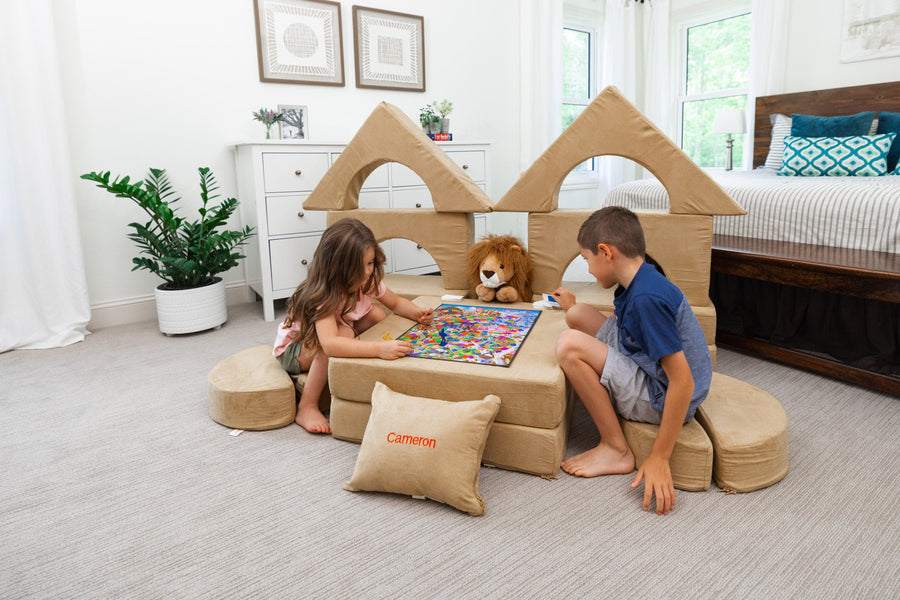


A foam couch for kids is a set of soft, rearrangeable foam pieces that works as a toddler sofa, climbing spot and fort kit. The signs your toddler is ready for one: they climb everything, get bored with toys quickly, love to jump and crash, build with whatever they find, and you hear yourself saying "be careful!" all day.
Toddlers rarely tell you what they need. They show you. They climb the bookshelf, drag the couch cushions across the room, launch themselves off the armchair and abandon the toy they begged for after about four minutes.
None of that is misbehavior. It is growth. Toddlers are built to move, explore and experiment, and when their surroundings do not make room for that, it shows. A foam couch for kids is one simple way to give all that energy somewhere to go. Here are five signs your toddler might be ready for one, three mistakes to avoid when you buy, and what to look for instead.
5 signs at a glance
| Sign | What your toddler may need | A setup to try | Pieces to use |
|---|---|---|---|
| 1They climb everything | A safe place to practice climbing and balance | A low climbing mountain | Wedges and squares |
| 2They get bored with toys quickly | Open-ended play that changes every day | A new starter build every few days | Any mix of pieces |
| 3They love jumping and crashing | Room for big, active movement | A soft landing zone next to a low step | Rectangles laid flat, plus one square |
| 4They build with anything they find | Materials made for building | A fort with an arch doorway | Arches, rectangles and a blanket |
| 5You say "be careful" all day | A space where movement is welcome | A dedicated play corner | A few low pieces on a non-slip rug |
These are general suggestions. Every child is different. Always supervise children during play.
Sign 1: They climb everything
In short: climbing is how toddlers build strength, balance and confidence.
If your toddler is scaling the sofa, the coffee table and anything else within reach, they are right on track. According to the CDC's developmental milestones, most children can climb on and off a couch or chair without help by around 18 months.
Rather than stopping the climbing, it often helps to redirect it to something designed for it. Soft, low foam pieces give toddlers a place to climb that feels safer and far less stressful for everyone watching. Start with a low mountain of wedges and squares, and add height only as their climbing gets steadier.
Sign 2: They get bored with toys quickly
In short: single-purpose toys get figured out fast, while open-ended toys keep changing.
Many toys are designed to do one thing. Once your toddler has worked out that one thing, the interest fades. That is a sign they are learning quickly, not a problem.
A foam couch for kids does not have a single use. Today it is a sofa, tomorrow it is a slide, and by Friday it is a pirate ship. Because there is no fixed answer, there is always something new to discover. Setting up a fresh starter build every few days, like a tunnel, a mountain or a reading nook, is often all it takes to spark a new game.
Sign 3: They love jumping and crashing
In short: some toddlers need lots of big movement, and a soft space makes that easier to allow.
Some toddlers seem to run on constant motion. They jump on the bed, crash into cushions and rarely sit still for long. Big, active movement is a normal part of how young children play, and the World Health Organization recommends that children aged 1 to 4 get at least 180 minutes of physical activity a day.
A soft landing zone, like a few rectangles laid flat beside a low square to step off, gives that energy a safe outlet. Many parents find the whole day feels calmer when big movement has a place to happen.

Sign 4: They build with anything they find
In short: stacking pillows and dragging chairs are early signs of a young builder.
Pillows stacked into towers. Chairs dragged into a circle. Blankets draped over anything that stands still. These are early signs of creativity and problem-solving.
Early childhood educators often describe four types of play that children move through as they grow, based on the work of researcher Sara Smilansky:
-
Functional play: repeating simple actions, like climbing up and sliding down again and again
-
Constructive play: building things, like towers, walls and forts
-
Pretend play: turning the fort into a castle, a shop or a spaceship
-
Games with rules: inventing games, like "the floor is lava"
A foam couch supports all four with the same set of pieces. A modular setup simply gives your child better tools for what they are already trying to do.
Sign 5: You say "be careful" all day
In short: if every corner feels risky, the space may not match what your toddler needs.
If your day is full of small warnings like "don't climb that" and "come down from there," it may not be about your child being too active. It may be that the room is not set up for how toddlers move.
Parenting a toddler is tiring in a very particular way. It is the constant risk-checking and redirecting that wears you down. When a child has a space designed for climbing and building, the corrections become less frequent, and many children play for longer stretches on their own. For you, that can mean a few minutes to actually sit down.
How a foam couch supports play and development
In short: it makes room for active play, building and pretend play in one place.
A well-designed foam couch for kids gives children lots of chances to practice:
-
Physical skills, like climbing, balancing and crawling
-
Problem-solving, like figuring out how to make a wall stand up
-
Pretend play, like turning a fort into a kingdom
-
Independent play, choosing what to build without being told how
The American Academy of Pediatrics report The Power of Play describes child-led play as important for young children's development. The National Institute for Play, founded by psychiatrist Dr. Stuart Brown, has long championed the value of free, self-directed play too. A foam couch does not do the developing for your child. It gives them plenty of room to do it themselves.
3 common mistakes to avoid when buying a foam couch for kids
Mistake 1: Not checking the foam
Foam quality affects everything. Foam that flattens quickly makes walls lean and builds wobble, and children lose interest when things keep falling down. Ask any brand for:
-
The foam density, in pounds per cubic foot
-
The firmness, as ILD or IFD
-
Whether the foam is CertiPUR-US® certified, and who makes it
Mistake 2: Choosing only flat cushions
A set of identical flat cushions can feel limiting after a while. Different shapes, like arches, wedges, half-moons, ramps and steps, open up tunnels, slides, bridges and castles. Shape variety matters as much as piece count.
Mistake 3: Treating it like furniture instead of a play system
A foam couch is not meant to stay in one position forever. The magic comes from rearranging it. Let your child take it apart, and set up something new every few days to keep it exciting.
What to look for instead
-
Well-specified, certified foam that holds its shape
-
A mix of shapes for different kinds of builds
-
Removable, machine-washable covers for everyday life
-
Pieces light enough for your toddler to move
-
A clear age range and a solid warranty
-
The option to add pieces later as your child grows
How FoamOh castles fit in

In short: two modular foam castles made for climbing, building and pretend play, from age 1 and up.
The Original Play Castle Sofa comes with 14 buildable pieces plus a personalizable pillow: half-moons, arches, triangle wedges, squares and rectangles. It is a great starting point for toddlers who are just beginning to climb and build.
The FoamOh Super Castle Play Sofa adds a Triangle Ramp, a Steps piece and a Circle, for 17 buildable pieces plus a pillow, which gives growing builders more to work with. You can also add those pieces later from our accessories collection.
Both castles have:
-
Furniture-grade, CertiPUR-US® certified foam (1.5 lb density, 40 ILD), made without flame-retardant chemicals
-
Removable microsuede covers you can machine wash (see our care guide)
-
A 3-year limited warranty
-
A design for ages 1 and up, for climbing, building and imaginative play. Not for sleeping. Always supervise children during play.
To see how families use the pieces, browse our castle builds page, read what parents say on our reviews page, or compare both castles in our castles collection.
How use changes as your toddler grows
| Stage | Ages | How they tend to use it |
|---|---|---|
| 1The Early Explorers | 1 to 2 years | Crawling over low pieces, pulling up and learning to climb |
| 2The Stackers | 2 to 3 years | Climbing, stacking, tunnels and early pretend play |
| 3The Fort Architects | 3 to 5 years | Forts, castles, stories and role play |
| 4The Big Idea Crew | 5 years and up | Big builds, obstacle courses and made-up games |
Every child develops at their own pace. Always supervise children during play.
Frequently asked questions
What is a foam couch for kids?
A foam couch for kids is a set of soft foam pieces that stacks into a child-sized sofa and comes apart for climbing, building forts, making tunnels and pretend play. Many sets include shapes like arches, wedges and half-moons for more ways to build.
What age is a foam couch for kids best for?
FoamOh castles are designed for ages 1 and up, for climbing, building and imaginative play. They are not designed for sleeping. Always supervise children during play.
Are foam couches safe for toddlers?
A well-made foam couch can give toddlers a soft place to climb and play when builds are kept low, the pieces sit on a flat, non-slip surface and a grown-up supervises. Look for certified foam and published foam specs.
What are the 4 types of play?
A common way to describe children's play, based on the work of researcher Sara Smilansky, uses four types: functional play (repeating simple actions), constructive play (building), pretend play (make-believe) and games with rules. A foam couch for kids can support all four.
Do foam couches help with child development?
A foam couch gives children lots of chances to climb, balance, build, solve small problems and play pretend, which are all part of healthy play in early childhood. Like any play equipment, it works best as part of plenty of active, child-led play.
How many pieces should a foam couch have?
Shape variety matters as much as piece count. A mix of flat pieces and shaped pieces, like arches, wedges and half-moons, supports more kinds of builds than lots of identical cushions. FoamOh castles come with 14 or 17 buildable pieces plus a pillow.
How do I clean a foam couch for kids?
With FoamOh castles, remove the covers from the foam, zip them closed and machine wash them in cold water with a mild detergent, then hang to dry. Keep the foam itself dry, and never put it in the washing machine.
Curious to dive deeper into open‑ended play?
Read how families use FoamOh! for open‑ended play →