

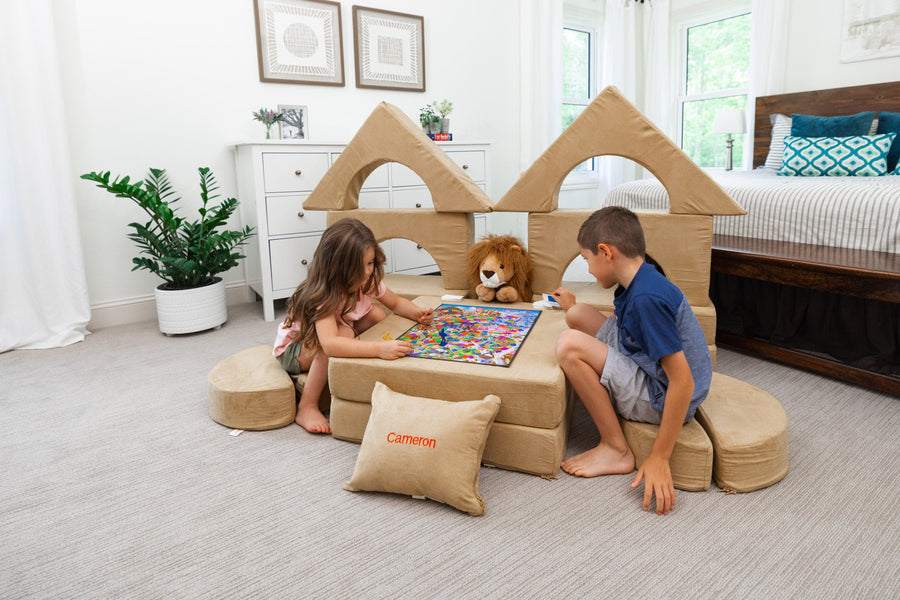


Foam density is how much foam material is packed into one cubic foot, measured in pounds per cubic foot (PCF). It is one of the best clues to how well foam will hold up over time. Firmness is a separate measurement, usually given as ILD. For kids' play furniture, look at both numbers, plus certification and design.
When you are comparing kids' play couches, it is easy to focus on what you can see: the number of pieces, the colors, the price. What is inside the covers matters just as much. Two couches can look identical on the day they arrive and behave very differently after a year of climbing, stacking and fort building.
This guide explains what foam density and firmness mean, how they differ, what to ask a brand before you buy, and exactly what is inside a FoamOh castle.

What is foam density?
In short: density is how much a cubic foot of foam weighs.
Density measures how much material is packed into the foam. It is expressed in pounds per cubic foot (PCF). If a cubic foot of foam weighs 1.5 pounds, it has a density of 1.5 PCF. If it weighs 2 pounds, the density is 2.0 PCF.
In general, more material means the foam can withstand more repeated squashing and still bounce back. That is why density is often used as a guide to durability. It is not the whole story, though, which brings us to firmness.
What is foam firmness, or ILD?
In short: firmness is how hard the foam feels when you press on it, and it is measured separately from density.
Firmness is usually given as ILD (indentation load deflection) or IFD (indentation force deflection). Both describe how much force it takes to press a sample of foam down by a set amount, usually 25%. A higher ILD means the foam feels firmer. A lower ILD means it feels softer.
This is where many parents get tripped up: density and firmness are separate properties. A foam can be dense but soft, or light but firm. Density tells you about the amount of material. Firmness tells you how the foam feels and supports weight.
You may also see foam described by a four-digit grade, like "1540". The first two digits are the density (1.5 PCF) and the last two are the firmness (40 ILD).
Density vs firmness at a glance
| Density | Firmness ILD / IFD | |
|---|---|---|
| What it measures | How much material is in the foam | How much force it takes to compress the foam |
| Unit | Pounds per cubic foot (PCF) | Pounds of force |
| What it tells you | A useful clue to how well the foam holds up over time | How soft or supportive the foam feels |
| What it affects in play furniture | How well pieces keep their shape with repeated use | How stable pieces feel for stacking, climbing and sitting |
| What it does not tell you | How firm the foam feels | How long the foam will last |
| In FoamOh castles | 1.5 lb density | 40 ILD |
Why foam matters more in kids' play furniture
In short: play furniture gets climbed, stacked, jumped on and rebuilt far more than an ordinary sofa.
An adult sofa mostly gets sat on. A kids' play couch gets climbed, jumped on, dragged across the room, stacked into towers, turned into forts and rebuilt many times a week. Every one of those activities compresses the foam.
Over time, foam that cannot keep up with that workload may start to show it. Walls that once stood straight may lean. Pieces that stacked neatly may start to slip. Surfaces may keep impressions from daily use instead of springing back. How quickly that happens depends on the foam's density and firmness, how the pieces are shaped, and how the couch is used.
What to ask a brand before you buy

In short: ask for real numbers and real names, not just "premium foam."
Brands that are confident in their materials are usually happy to share the details. Before you buy, ask:
-
What is the foam density, in PCF?
-
What is the firmness, as ILD or IFD?
-
Is the foam CertiPUR-US® certified, and who makes it?
-
Is the foam made without flame-retardant chemicals?
-
Are the covers removable and machine washable?
-
What ages is it designed for, and how should it be used?
-
What does the warranty cover, for example if foam splits, cracks or sags?
If the answers are vague, like "premium foam" or "high-quality materials" with no numbers, it is worth asking again.
Other things that affect how long foam lasts
In short: density and firmness matter, and so do shape, covers, care and certification.
Foam numbers are only part of the picture. These also make a difference:
-
Piece design. Well-proportioned pieces with a stable base stay steadier in builds.
-
Covers. Snug, sturdy covers help pieces keep their shape and protect the foam.
-
Care. Using the pieces on a firm, flat surface and not storing them under heavy objects helps them last.
-
Certification. CertiPUR-US® certified foam is independently tested for content, emissions and durability.
-
Warranty. A good warranty shows how the brand stands behind its foam over time.
What is inside a FoamOh castle
In short: 1.5 lb density, 40 ILD, CertiPUR-US® certified foam, with the supplier listing available for you to check.
We think parents should never have to guess what is inside the furniture their children play on, so here are our numbers:
FoamOh castles
Our 40 ILD rating means the pieces are firm enough to stack into walls and climb on, while still soft enough for lounging and tumbling. Both of our castles use the same foam: The Original Play Castle Sofa, with 14 buildable pieces plus a pillow, and the FoamOh Super Castle Play Sofa, with 17 buildable pieces plus a pillow. They are designed for ages 1 and up, for climbing, building and imaginative play. Not for sleeping. Always supervise children during play.
You can read more about the certification in our guide to what CertiPUR-US® certified means, see how families put the pieces to work on our castle builds page, and read the full terms on our warranties page.
Looking after your foam
In short: a firm surface, clean covers and a little reshaping help foam last.
-
Use pieces on a firm, flat surface, like a floor or rug.
-
Keep foam dry. Remove covers before cleaning so moisture does not soak into the foam.
-
Avoid storing pieces under heavy objects for long periods.
-
Give pieces a quick reshape by hand after long periods of heavy use.
Our care guide has full washing and care instructions.
Thinking about long-term value
In short: compare cost per year of use, not just the price on the box.
A cheaper play couch can look like the better deal until it needs replacing. When you compare options, think about how many years of daily use you expect, what the warranty covers, and whether you can buy replacement covers or extra pieces later. A couch that stays in use for years usually costs less per year than one that has to be replaced quickly.
The bottom line

Foam density is a useful clue to durability, and firmness tells you how the foam will feel and support your child. Neither number tells the whole story alone, so look at them together, along with certification, design, covers and warranty. And do not be shy about asking a brand for real numbers. The good ones will tell you.
Frequently asked questions
What is foam density?
Foam density is how much a cubic foot of foam weighs, measured in pounds per cubic foot (PCF). It tells you how much material is packed into the foam and is a useful clue to how well it will hold up over time.
What is the difference between foam density and firmness?
Density measures how much material is in the foam, in pounds per cubic foot. Firmness, measured as ILD or IFD, describes how much force it takes to compress the foam. They are separate properties, so a foam can be dense but soft, or light but firm.
What does ILD mean?
ILD stands for indentation load deflection. It measures how much force it takes to press a sample of foam down by a set amount, usually 25%. A higher ILD means firmer foam, and a lower ILD means softer foam.
What density and firmness is FoamOh foam?
FoamOh castles use furniture-grade foam with a density of 1.5 pounds per cubic foot and a firmness of 40 ILD, often written as grade 1540. The foam is CertiPUR-US certified and made without flame-retardant chemicals.
Who makes FoamOh's foam?
FoamOh's foam is made by HLJ Foam Products, which is listed as a certified foam producer on the CertiPUR-US website.
What should I ask a brand about its foam?
Ask for the foam density in PCF, the firmness as ILD or IFD, whether the foam is CertiPUR-US certified and who makes it, whether it is made without flame-retardant chemicals, what ages it is designed for, and what the warranty covers.
How can I make play couch foam last longer?
Use the pieces on a firm, flat surface, keep the foam dry, remove covers before cleaning, avoid storing pieces under heavy objects, and reshape pieces by hand after long periods of heavy use.