

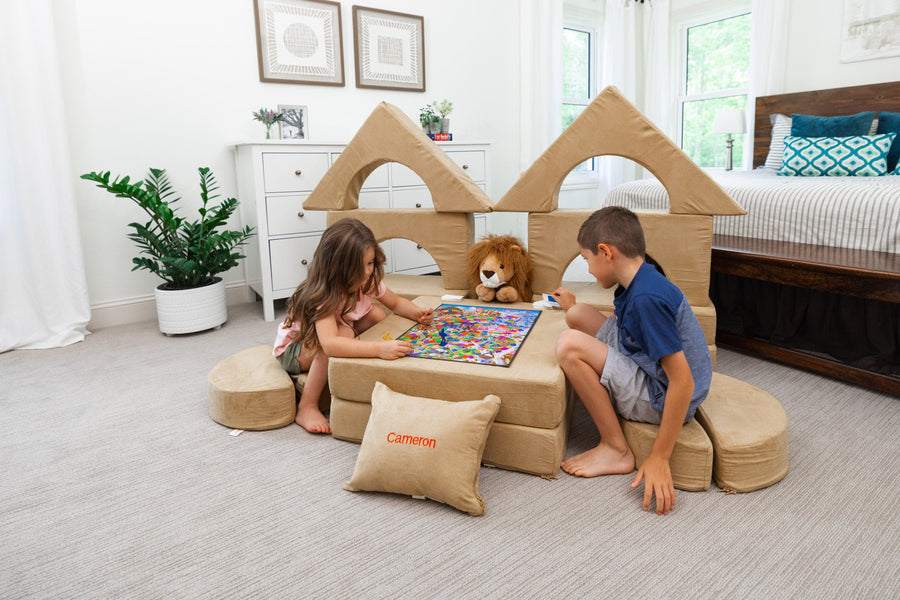


The best indoor fort ideas are simple: a blanket over two chairs, a pillow mountain, a cardboard box castle, or a foam fort built from modular pieces. Keep forts low, cozy and easy to crawl out of, let your kids help build them, and add a flashlight, a few books and a favorite stuffed animal.
There is something about a fort. Throw a blanket over two chairs and watch your child disappear inside it for the rest of the afternoon, narrating an entire world to themselves. The best forts are wonderfully simple, which is exactly why they work.
With winter break, snowy weekends and holiday visitors on the way, forts are one of the easiest ways to fill a long day indoors. This guide has 15 fort ideas for toddlers and older kids, a quick comparison of fort materials, a step-by-step foam fort, and a few safety tips. No hot glue. No Pinterest pressure. Just good, imaginative play.
Why forts are such a good screen-free activity
In short: forts give children their own space, and a reason to build, imagine and play for hours.
A fort is a child's way of saying: this space is mine, and in here, I make the rules. Building one involves planning, problem-solving and plenty of trial and error. Playing inside one usually turns into a story, whether it is a castle, a spaceship or a bakery.
The American Academy of Pediatrics report The Power of Play describes unstructured, child-led play as important for children's development, including problem-solving and social skills. Fort building is child-led play at its best.
Many children also simply love small, cozy spaces. A fort can be a lively headquarters one minute and a quiet reading den the next, which makes it a lovely place to slow down after a busy day.
What makes a great indoor fort?
In short: cozy, low, easy to build and easy to change.
A great fort does not need to be photo-worthy. It just needs to be:
-
Enclosed enough to feel like a real hideaway
-
Low to the ground so it is safe to climb in and out
-
Big enough for your child plus a stuffed animal or a friend
-
Simple enough that your child can help build it
-
Easy to change, so tomorrow's fort can be something new
Fort materials compared
In short: blankets are free and flexible, and modular foam is the most stable and reusable.
| Material | Cost | Stability | Reusable? | Good for |
|---|---|---|---|---|
| Blankets and chairs | Free | Low, since blankets slip and chairs can tip | Yes | All ages, with supervision |
| Couch cushions | Free | Low to medium | Yes | All ages |
| Cardboard boxes | Free or very low | Medium | Short-lived | Toddlers and up, with a grown-up handling any cutting |
| Pop-up tents | Low to moderate | Medium, but the shape is fixed | Yes | Toddlers and up |
| Modular foam castleFoamOh | Higher upfront: $254 (14 pieces) or $379 (17 pieces) | High, because the pieces hold their shape | Yes, rebuild it every day | Ages 1 and up. Not for sleeping. |
FoamOh prices are standard retail prices as of 30 September 2026.
For an occasional fort, blankets and chairs are hard to beat. If you want fort building to be a regular part of your week, a modular foam set gives you sturdier walls and endless rebuilds.
Classic blanket and pillow forts
In short: zero cost, five minutes, hours of fun.
1. The classic chair tent
Pull four dining chairs into a square and drape a flat sheet over the top. Tuck the edges under books or cushions on the chair seats to hold it in place.
2. The pillow mountain
Gather every pillow and couch cushion in the house and pile them into a soft dome. Drape a blanket over one side as a roof, and your toddler will think you are a genius.
3. The bunk bed cave
If you have a bunk bed, tuck a sheet or curtain around the bottom bunk for an instant, private hideout. In many homes this one stays up for weeks.
4. The couch cushion lean-to
Stand two large cushions against the side of the sofa and drape a blanket from the sofa arm across them. It is low and cozy, which makes it perfect for smaller toddlers.
Easy fort ideas for toddlers

In short: low, soft and easy to crawl in and out of.
5. The cardboard box castle
Collect a few large boxes, tape them together, and cut out windows and a door. (Grown-ups handle the cutting.) Hand your toddler crayons, and by lunchtime they will be decorating the walls.
6. The pop-up tunnel fort
Connect a pop-up play tent to a fabric tunnel for a two-room fort your toddler can crawl through again and again.
7. The laundry basket hideout
For the littlest builders, drape a light blanket over an upside-down laundry basket and a couple of cushions to make a tiny den for a favorite stuffed animal. Toddlers love tucking their toys in for a pretend nap.
8. The corner cocoon
Push two armchairs into a corner facing each other and drape a large blanket from one chair back to the other. The walls do half the work for you.
Modular foam fort ideas
In short: sturdy foam pieces hold their shape, so forts stay up and can be rebuilt every day.
This is where fort building becomes something your kids come back to week after week. Because foam pieces keep their shape, walls do not collapse the moment a toddler leans on them.
Our castle builds page is the best place to start. It has free downloadable build guides and real forts from FoamOh families. Here are a few favorites to try with The Original Play Castle Sofa (14 buildable pieces plus a pillow) or the FoamOh Super Castle Play Sofa (17 buildable pieces plus a pillow). Both are designed for ages 1 and up, for climbing, building and imaginative play. Not for sleeping. Always supervise children during play.
9. The castle keep
Use the arches as a grand entrance, line up rectangles as castle walls, and add squares and half-moons as towers and turrets. Lay a flat rectangle at the doorway as a drawbridge, and drape a blanket over the top for a roof.
10. The tunnel maze
Line up the arches with rectangles on either side to make a crawl-through tunnel, then add a turn or two. Expect it to be crawled through seventeen times in a row.
11. The command center
Arrange the pieces in a wide semicircle, like a cockpit, with a blanket roof overhead and a flashlight inside. Suddenly your living room is mission control.
12. The reading nook
Make low side walls from rectangles and half-moons, add the pillow inside, and drape a soft blanket over the top. Add picture books and a battery-powered lantern for the coziest reading spot in the house.
With the Super Castle, the Triangle Ramp makes a slide out of the front door, the Steps piece becomes a staircase up to a lookout, and the Circle makes a round tower. You can also add those pieces to any castle from our accessories collection.
Themed forts for older kids

In short: give older kids a theme and step back.
13. The spy headquarters
String yarn across the inside of the fort at different heights, like a laser security system. Hand over a "mission briefing" on a folded note and let them take it from there.
14. The underwater base
Hang blue sheets, tape paper fish to the walls and stick glow-in-the-dark stars on the ceiling. Play ocean sounds from a speaker outside the fort.
15. The indoor campout
Set up a small tent in the living room with a pretend "campfire" made from tissue paper and a battery-powered LED light. Add a snack, a flashlight and a campfire story. It is perfect for a winter-break movie night or a visit from cousins.
How to build a foam fort, step by step
In short: about ten minutes, and your kids can do most of it with you.
-
Clear a corner or a patch of open floor.
-
Lay two rectangles flat as the floor.
-
Build the walls along each side with rectangles and half-moons. If a wall wobbles, lean it against the sofa or a wall for support.
-
Place an arch at the front as the doorway.
-
Drape a lightweight blanket over the top as the roof.
-
Add the pillow, a flashlight and your child's favorite stuffed animal.
-
Let your child name it. This step is not optional. The naming is half the magic.
When playtime is over, the pieces stack back into a sofa. The covers are removable and machine washable, which helps when snacks inevitably make their way inside. See our care guide for washing tips.
Fort safety tips
In short: keep forts low, stable and light on top, and stay nearby.
-
Chairs can tip, especially when children lean or pull on them. Use sturdy chairs, and push them against a wall where you can.
-
Keep roofs light. Use blankets and sheets for roofs, and never put heavy objects on top of a fort.
-
Keep forts low for toddlers so they can crawl in and out easily.
-
Use battery-powered lights only, never candles or hot lamps.
-
Keep cords and strings out of reach of younger children, and take down string "lasers" after play.
-
Use foam castle pieces for play, not for sleeping.
-
Supervise young children, especially during building.
Fort ideas by age
In short: toddlers need cozy, preschoolers want to build, and older kids want a challenge.
Toddlers (about 1 to 3)
Keep it low, soft and easy to exit. Toddlers do not need height. They love enclosure. A blanket cave, a cardboard box or a simple foam den with a blanket roof is plenty. Add a soft pillow and a favorite stuffed animal.
Preschoolers (about 3 to 5)
At this age, building is half the fun. Let them carry pieces, drape blankets and decide where the door goes. Themed forts, like a castle, a rocket or a bakery with a blanket counter, are big hits.
Kids 5 and up
Hand them the materials and set a challenge: build it without tape, make it big enough for two, give it two rooms. Then let them figure it out.
Give them a space to call their own
The best indoor fort ideas are the ones that actually happen: the chairs you pull out on a snowy morning, the blanket you toss over them, the moment your child crawls inside and starts telling a story. Start simple, let them add to it, and let them rename it three times.
For more ideas all winter long, download the free guides on our castle builds page, or compare both castles in our castles collection.
Frequently asked questions
What are some easy indoor fort ideas?
Easy indoor fort ideas include a blanket over four chairs, a pillow mountain, a cushion lean-to against the sofa, a cardboard box castle and a corner fort with two armchairs. Modular foam pieces make sturdier forts that can be rebuilt into something new every day.
What age is fort building best for?
Children of almost every age enjoy forts. Toddlers love small, cozy enclosures, preschoolers enjoy helping to build and playing pretend inside, and older kids love the challenge of designing bigger, more complicated forts. Always supervise young children during building.
What do you need to build an indoor fort?
A simple fort needs just a couple of chairs and a sheet or blanket. Cushions, pillows, clothespins and a flashlight make it cozier. For a sturdier, reusable fort, modular foam pieces hold their shape without tape or tools.
How do you make a fort that does not fall down?
Build with a wide, low base, push the fort against a wall or into a corner, and tuck blanket edges under something weighty so they do not slip. Use light blankets for the roof. Foam pieces that hold their shape also make much more stable walls than cushions.
Are indoor forts safe for toddlers?
Forts can be a safe and fun space for toddlers when they are kept low, built from soft materials and easy to crawl out of. Avoid tippy chairs and heavy roofs, use battery-powered lights only, and always supervise young children.
Can a play couch be used as a fort?
Yes. A modular play couch is one of the easiest ways to build a sturdy fort, because the foam pieces hold their shape as walls, doorways and tunnels. FoamOh castles are designed for ages 1 and up, for play rather than sleeping, and the pieces stack back into a sofa when playtime is over.
What are the best fort ideas for small spaces?
Corner forts work best in small spaces, because the walls do half the work. A bunk bed cave or a small foam den with a blanket roof also takes up very little room, and foam pieces stack neatly back into a sofa between builds.