


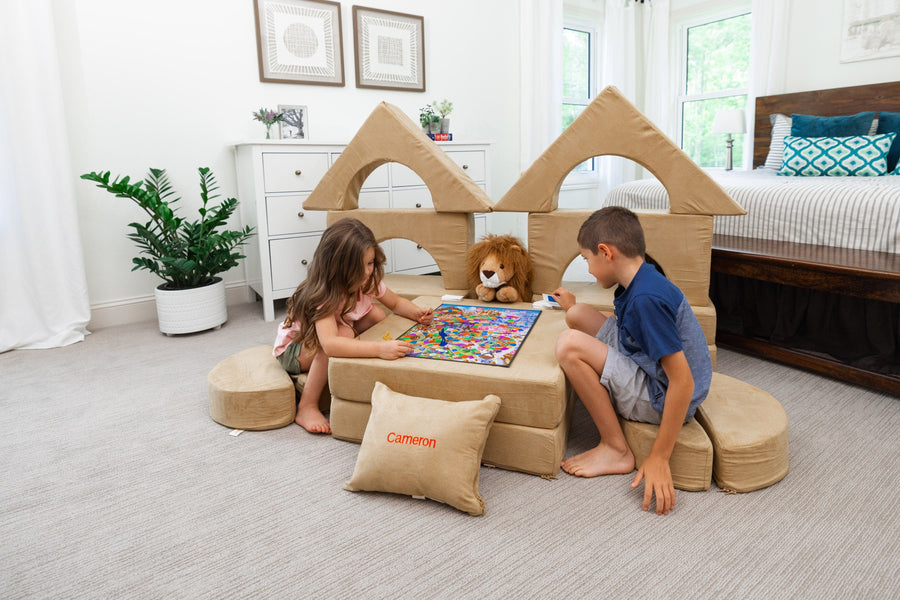


A modular toddler couch and a foam floor play mat are both soft, both made for floor play, and both popular in playrooms, but they do different jobs. A play mat is a cushioned surface that children play on. A modular toddler couch is a set of foam pieces that children play with: they climb it, build forts from it and sit on it as a sofa. For babies under 12 months, a mat is the better fit. From about 18 months on, a modular couch usually offers more play, for more years.
If you are setting up a playroom for a toddler, both options are probably on your list already. They overlap in obvious ways, and plenty of families end up owning both. Still, they solve different problems, and knowing which problem your child has right now is the key to spending well.
Below you will find what each option does well, a side-by-side comparison table, how each one fits your child at every stage from baby to big kid, when it makes sense to have both, a buyer checklist for each, and answers to the questions parents ask most.
What floor play mats do well
Foam floor play mats come in two main types. Interlocking puzzle tiles are usually made of EVA foam and are often about half an inch to an inch thick. Tumbling or gymnastics mats are thicker, often 2 to 4 inches, and usually come as one piece or a folding panel mat.
Their main job is to make a hard floor softer. A good mat cushions tumbles, takes the chill off a tile or wood floor, and marks out a clear play zone. That last part matters more than it sounds: a mat tells a little one "this is your space," and it tells grown-ups where the toys belong.
Where floor play mats are at their best
-
The baby months. The American Academy of Pediatrics encourages supervised tummy time every day while your baby is awake. A clean, flat mat on the floor is a simple place to do it, along with rolling and reaching play.
-
Defining a play zone in a shared living room or a corner of a bedroom.
-
Under active play. A tumbling mat under a climbing area or a practice space for forward rolls adds a soft landing.
-
A smaller budget. Puzzle mats often cost roughly $30 to $60, and tumbling mats roughly $80 to $200, depending on size and thickness.
Where floor play mats hit their limits
-
They are a surface, not a toy. Children play on a mat, not with it.
-
They stay flat. Puzzle tiles can change shape, but they never stand up into a wall, a tunnel or a seat.
-
They do less as kids grow. Once a child walks and runs confidently, a thin mat offers little that a rug does not.
-
Materials vary. Some EVA puzzle mats were found to release formamide, and the European Union now limits formamide in foam toy materials. It is worth checking what a mat has been tested for before you buy.
What a modular toddler couch adds

A modular toddler couch, also called a kids play couch, is a set of firm foam pieces in removable covers. Put together, the pieces make a child-sized sofa. Pulled apart, they become whatever your child decides: a mountain, a tunnel, a boat, a castle.
That is the real difference. A mat waits for the play to happen on top of it. A play couch becomes part of the play. As children grow, they use the same pieces in new ways:
-
Around 12 to 18 months: low pieces become steps to climb, edges to cruise along and soft spaces to crawl into.
-
Around 2 years: a simple fort, a tunnel or a cozy cave. Pretend play is starting, and a space that can "be" something is perfect for it.
-
From 3 to 5 years: full forts, castles, obstacle courses and themed worlds that take a whole afternoon to build.
-
From 6 years on: a reading nook, floor seating for movie night and still the best fort in the house.
Pretend play grows a lot in these years. The CDC developmental milestones list simple pretend play, like feeding a block to a doll as if it were food, as something many children do by 30 months. The AAP report The Power of Play notes that simple, open-ended materials often support play better than toys that do just one thing. Soft pieces that can be anything fit that description well.
What a modular toddler couch does that a play mat cannot
-
Offers low, soft climbing from the toddler years on
-
Makes enclosed spaces, like dens and tunnels, that many toddlers love to tuck into
-
Gives pretend play a setting: the fort becomes a house, a boat or a cave
-
Turns back into a real piece of kids furniture at the end of the day
-
Keeps up with your child for years instead of retiring after the baby stage
Side-by-side comparison: modular toddler couch vs floor play mats
| Feature | Modular toddler couch | Floor play mats |
|---|---|---|
| Soft surface | Yes, firm foam pieces in soft covers | Yes, EVA tiles or tumbling foam |
| Climbing | Yes, low pieces to climb and step on | No |
| Forts and enclosed spaces | Yes, tunnels, dens and castles | No |
| Pretend play | Pieces become houses, boats and caves | Mostly a backdrop for other toys |
| Changes shape | Yes, a new build every day | Tiles rearrange, but stay flat |
| Works as furniture | Yes, a kid-sized sofa | No |
| Best ages | FoamOh castles: ages 1 and up | Most useful in the baby and early toddler months |
| Foam certification | FoamOh: CertiPUR-US® certified foam | Varies, look for ASTM F963 or EN 71 testing |
| Cleaning | FoamOh: removable, machine-washable covers | Usually wipe clean |
| Price | FoamOh: $254 (14 buildable pieces + 1 pillow) or $379 (17 buildable pieces + 1 pillow) | Roughly $30 to $60 for puzzle mats, $80 to $200 for tumbling mats |
| Cost per year over 5 years of use | About $51 (Original) or $76 (Super Castle) | Low, if the mat stays in use that long |
Mat prices are typical ranges and vary by size and brand. FoamOh prices are current list prices. Cost per year is simple math, not a promise of how long any product lasts.
How each option fits your child at every stage
Under 12 months: the floor mat leads
Babies spend most of their play time on their backs and tummies, so a clean, flat surface is exactly what they need. A mat works well for tummy time, rolling and early reaching. Always supervise tummy time, and keep it to awake time only.
FoamOh castles are designed for kids ages 1 and up, so at this stage a mat is the right choice.
12 to 18 months: both work, and the couch starts to pull ahead
Now toddlers are pulling up to stand, cruising along furniture and trying their first climbs. A modular couch fits this stage beautifully. Low pieces become steps, and a Half-Moon or two makes a gentle hill to scramble over. A mat still gives them a soft place to sit and play, but it does not add anything to climb.
If you only want to buy one thing this year, this is when a play couch starts to pay off. Stay close, keep builds low and always supervise play.
18 months to 3 years: the modular couch wins
This is when pretend play takes off. A tunnel becomes a cave for a bear family. Two Arches and a blanket become a house. A row of Rectangles becomes a train. A mat cannot do any of this, because there is nothing to build.
The FoamOh Original Play Castle Sofa is a great fit here: 14 buildable pieces + 1 pillow, including 4 Half-Moons, 2 Arches, 2 Triangle Wedges, 2 Squares and 4 Rectangles.
3 to 5 years: no contest
Preschoolers build big. They want walls, doors, towers, ramps and a secret room for the dog. A mat at this age is just floor covering. A modular couch is right in its sweet spot. The same pieces can be a castle in the morning and an obstacle course after lunch.
Need inspiration? Our illustrated play couch builds show forts, tunnels, ramps and cozy dens your child can try.
5 years and up: the couch stays, the mat retires
Older kids still build, and they also want a comfortable spot of their own. A quality play couch becomes their reading nook, movie night seat and hangout spot. Most foam mats get rolled up and stored by now.
The FoamOh Super Castle Play Sofa adds a Triangle Ramp, Steps and a Circle, for 17 buildable pieces + 1 pillow. It is a good fit for big builders and siblings who share. You can browse both castles here.
Can you use both? When it makes sense
For many families, the answer is yes, at least for a while. Having both makes the most sense when:
-
You have a baby and an older sibling. The baby gets a mat for tummy time, and the older child gets something to build with.
-
You want extra cushioning under climbing play. A tumbling mat under a low build adds a soft landing zone on a hard floor.
-
Your play space is on tile or hardwood. A mat or rug under the play area keeps pieces from sliding and makes floor play warmer.
Once your youngest is past 18 months, a modular couch usually covers most of what the mat did, plus a lot more.
How FoamOh pieces cover mat use cases
-
Rectangles and Squares laid flat side by side make a soft floor area for sitting, rolling and floor play.
-
Low builds with Half-Moons and a Square or two make a gentle climbing and landing zone.
-
Everything packed back up becomes a sofa, so your play area does not have to stay covered all day.
Not sure which castle fits your space? Our kids play couch guide compares both, or you can take the castle quiz.
What to look for when choosing either option
For a modular toddler couch
-
Certified foam. Look for CertiPUR-US® certification, which means the foam was tested by independent labs against content and emissions criteria. FoamOh castles use CertiPUR-US® certified foam.
-
Clear foam numbers. Ask for density and firmness (ILD), so you know the pieces will hold their shape when kids climb and build. FoamOh uses sofa-quality foam, firm enough to climb and build on: 1.5 lb density, 40 ILD (a medium-firm feel).
-
Removable, washable covers. Spills happen daily with toddlers. FoamOh covers are removable microsuede and machine washable.
-
Pieces sized for small kids. Low, light pieces that a toddler can move and climb on with a grown-up nearby.
-
Where it is made. FoamOh castles use U.S.-made foam, assembled in Tennessee.
-
Clear age and use guidance. FoamOh castles are for ages 1 and up, for imaginative play, not for sleeping.
For foam floor play mats
-
Safety testing. Look for mats tested to toy safety standards such as ASTM F963 or EN 71, and skip mats with no safety information at all.
-
The right thickness. Thin puzzle tiles are fine for marking a play zone. For tumbling and active play, choose a thicker tumbling mat.
-
Non-slip backing if the mat goes on a hard floor.
-
Easy cleaning. A surface that wipes clean quickly.
-
Tight-fitting tiles. Gaps and lifted edges can trip a new walker, so check the joints often.
Toddler couch vs play mat: frequently asked questions
Is a toddler couch better than a play mat?
For most toddlers over 18 months, a modular toddler couch offers more play than a floor mat. A mat is a cushioned surface. A modular couch is something children climb, build forts from and use as a sofa, so it keeps up as they grow. For babies under 12 months, a clean, flat play mat is the better choice.
What is the best indoor play equipment for a 2-year-old?
At 2, the best indoor play equipment mixes gentle physical challenge, like low climbing, with room for pretend play, like forts and hideaways. A modular toddler couch does both. Add a rug or tumbling mat underneath on hard floors, and always supervise play.
Are foam tumbling mats safe for toddlers?
Quality foam tumbling mats are generally a good choice for toddlers when used with supervision. Look for mats tested to toy safety standards such as ASTM F963 or EN 71, choose a thickness that suits tumbling, use a non-slip backing on hard floors, and skip mats with no safety information.
Can a play couch replace a play mat for toddlers?
For toddlers 12 months and older, a modular play couch can cover most of what a mat does. Flat pieces laid side by side make a soft floor area, and low builds add climbing that a mat cannot. For babies under 12 months, a dedicated play mat is still the better surface.
What is a toddler sofa bed, and is it worth buying?
A toddler sofa bed is usually a small foam chair or couch that folds out flat. It works as compact seating, but it offers little building or climbing play compared with a modular couch. If play value matters most, a modular toddler couch gives you more. FoamOh castles are designed for imaginative play, not for sleeping, so plan sleep separately and follow your pediatrician's safe sleep advice.
What are the best toys for active toddlers indoors?
The best indoor toys for active toddlers invite them to move and imagine at the same time: modular foam play couches for climbing and fort building, low climbing arches and ramps, ride-on toys, and simple sensory play. The common thread is that the toy asks the child to do something, not just watch or press buttons.

One is a surface, the other is a system
Floor play mats are good at what they do: they give babies and young toddlers a soft, clean place to play on the floor. That is also where their job ends. A modular toddler couch starts there and keeps building, with climbing at 1, forts at 2, full castles at 4 and a favorite reading spot at 8.
For most families with a toddler and an eye on the next few years, a toddler couch is the purchase that keeps finding new uses. FoamOh castles bring that together with CertiPUR-US® certified foam, firm enough to climb and build on, and removable, machine-washable covers.
Explore the FoamOh Original Play Castle Sofa · Browse all FoamOh castles · See build ideas
FoamOh castles are designed for ages 1 and up, for imaginative play, not for sleeping. Always supervise children during play.