


The best educational toys for 2 year olds (and 3 year olds) are open-ended: blocks, play dough, pretend play props, puzzles, books, balls and soft building pieces like a modular play couch. They grow with your child. Most toys sold as educational do one thing and get outgrown within months. Choose toys where your child does the thinking.
Every family has one. The toy graveyard. Maybe it is a bin in the closet, maybe it is the bottom shelf of the playroom. It holds the farm that sings the alphabet, the tablet that says “great job!” no matter what you press, and the shape sorter that was fascinating for exactly eleven days.
Meanwhile, the same wooden blocks have been in use since your child was 1. They were teething toys, then towers, then a fence for the plastic horses, and last week they were a “bakery.” Same blocks. Very different play.
That is the whole idea of toys that grow. Below, we look at what actually makes a toy educational, why so many “learning” toys get outgrown so fast, a simple five-question test you can use in any toy aisle, and our picks for the best educational toys for toddlers, 2 year olds and 3 year olds.
Quick picks: educational toys for 2 and 3 year olds
These eight toys get years of use, not months, because your child keeps finding new ways to play with them.
| Toy | Why it grows | Ages | Rough price |
|---|---|---|---|
| Chunky blocks | Knocked down at 2, towns and bridges by 4 | 1 to 5+ | $20 to $60 |
| Play dough and simple tools | Squished at 2, bakeries and letters by 4 | 2 to 6 | $10 to $25 |
| Knob puzzles, then jigsaws | From three big pieces to floor puzzles | 1 to 5 | $10 to $25 |
| Pretend play kit (kitchen, doctor, shop) | Copying you at 2, stories with roles at 3 to 5 | 2 to 6 | $20 to $80 |
| Board books and picture books | Pointing at 2, favorite stories at 3, “reading” to a teddy at 4 | 1 to 6 | $5 to $15 each |
| A soft ball | Rolled at 2, kicked and caught at 3, team games by 5 | 1 to 6 | $5 to $20 |
| Large beads and laces | Threading at 3, patterns at 4 to 5 | 3 and up (check label) | $10 to $20 |
| Modular play couch: FoamOh Original Play Castle Sofa | Climbing at 1 to 2, forts at 3, big builds and a reading sofa at 5 | 1 and up | $254 ($379 for the Super Castle) |
Prices are typical ranges and vary by brand and size. FoamOh prices are current list prices. Always check the age label and supervise young children during play.
What actually makes a toy educational?
Here is the slightly surprising answer: the child does, not the toy.
In 2019, the American Academy of Pediatrics published a report on selecting appropriate toys for young children. It encourages families to choose simple, traditional toys, like blocks, puzzles, pretend play items and books, and it points out that the best toys are the ones that get parents and children playing and talking together. It also notes that toys do not need screens or batteries to be educational.
A toy teaches the most when your child has to figure something out: how to balance the top block, where the puzzle piece goes, what the stuffed bear wants for dinner. That figuring out is the learning.
Why most educational toys get outgrown so fast
Most educational toys get outgrown fast because they have one job, and once your child has done it, there is little left to discover. It is not because they are bad toys. It is usually one of these:
- They have one job. A toy that teaches shapes is done when your child knows shapes.
- The toy does the work. Press a button, hear a song. Your child is the audience, not the inventor.
- The age band is narrow. “Ages 18 to 24 months” on the box is an honest warning.
- The surprise wears off. Once a child knows what the toy does, there is not much left to discover.
Compare that with a cardboard box. It has no lights, no songs and no lesson plan, and it has been a car, a boat, a house and a hat. Every parent who has bought a big gift and watched their child play with the box has seen this firsthand.
The five-question test for toys that grow
Before you buy, ask these five questions. A toy with three or more yeses has a good chance of lasting.
- Can it be played with at least three different ways?
- Does my child do the work, or does the toy?
- Will it still be interesting a year from now?
- Can a sibling or friend join in?
- Does it mix well with other toys? Blocks plus cars plus animals is a whole town. A singing farm mostly plays alone.
How classic toys grow from age 2 to 5
The toys that keep earning their spot on the shelf are the ones your child uses differently every year. Here is how the same toy changes as your child does.
| Toy | At 2 | At 3 | At 4 to 5 |
|---|---|---|---|
| Blocks | Stack two or three, knock down, repeat | Towers, roads and fences for animals | Whole towns, bridges and “do not touch” signs |
| Play dough | Squish, poke, roll | Snakes, balls and “cookies” | Pretend bakeries, letters and little creatures |
| Pretend play props | Copying you: stirring, phoning, feeding a doll | Simple stories with roles | Long stories with friends, costumes and rules |
| Puzzles | Chunky knob puzzles | Simple jigsaws with a few pieces | Bigger jigsaws and floor puzzles |
| Crayons and paper | Scribbles | Circles and lines | People, houses and “this is our family” |
| Balls | Roll, throw, chase | Kick, catch with two arms | Simple games with rules and teams |
| Books | Point at pictures, name things | Favorite stories on repeat | Longer stories and “reading” to a teddy |
| Modular play couch | Climbing, crawling through tunnels, small dens | Forts, shops, rockets and castles | Big builds with friends, obstacle courses, a reading sofa |
Ages are a rough guide. Children move at their own pace, and that is completely normal. Always supervise young children during play.
Educational toys for 2 year olds
The best educational toys for 2 year olds let them use their whole body and start to pretend. Two year olds are busy. They run, climb, carry, dump and repeat. They are also starting to put words together and copy everything you do. The CDC developmental milestones list kicking a ball and saying at least two words together, like “more milk,” as things many children do by 2.
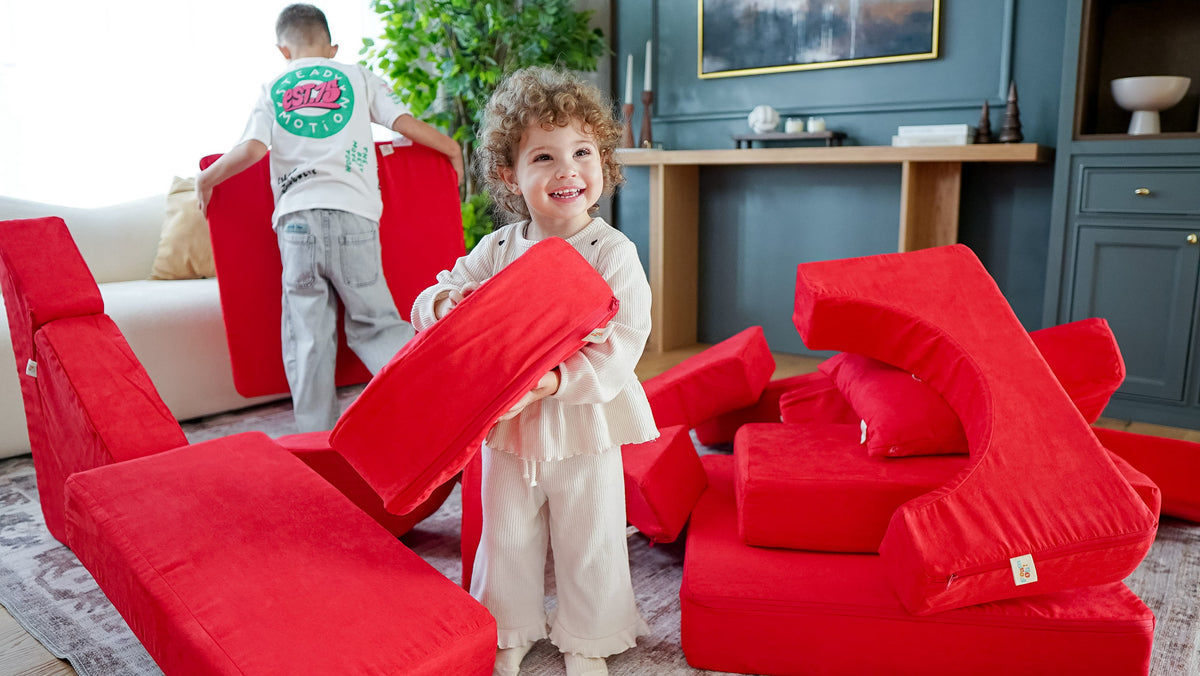
- Chunky blocks for stacking, lining up and knocking down.
- Knob puzzles with a few large pieces.
- A ball to roll, throw and kick, ideally somewhere with space.
- Simple pretend props: a toy phone, a pot and spoon, a doll or stuffed animal to look after.
- Board books with real-life pictures to point at and name.
- Something to climb: low and soft, so all that climbing energy has somewhere to go. Always supervise.
Educational toys for 3 year olds
The best educational toys for 3 year olds support pretend stories, more precise little hands and playing with other kids. The CDC milestones list stringing large beads and drawing a circle when shown how as things many children do by 3. Children at this age also start playing with other kids, not just next to them.
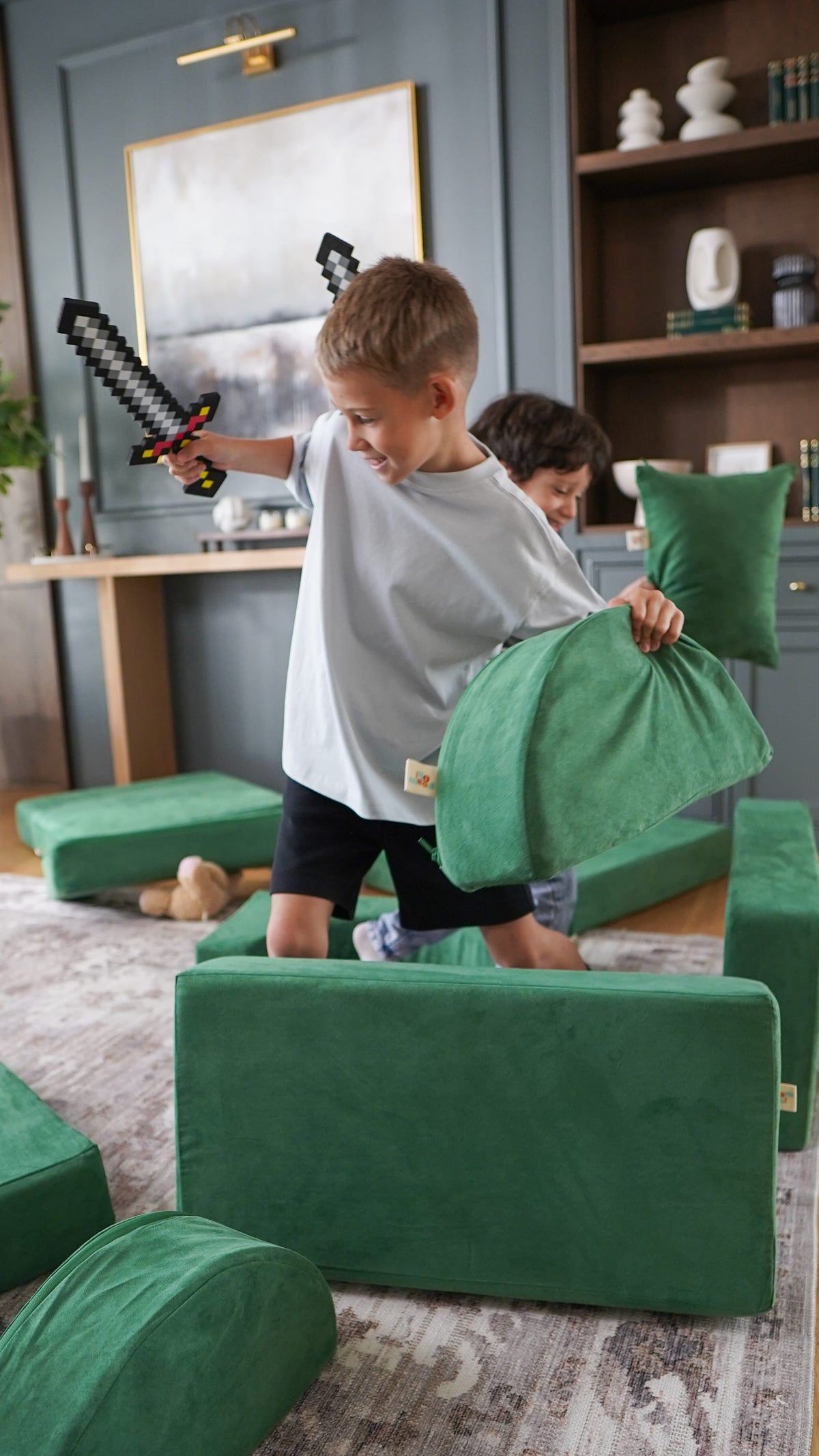
- Large beads and laces for threading.
- Play dough and simple tools like a rolling pin and cookie cutters.
- Jigsaw puzzles with a handful of pieces.
- Dress-up clothes and pretend kits: a doctor kit, a play kitchen, a shop.
- Building sets they can make into anything, from blocks to soft foam pieces.
- Crayons, chalk and big paper.
Educational toys for 2-3 year olds: the sweet spot
For a child between 2 and 3, or siblings close in age, pick toys that work at both levels, because they get two or three good years instead of six months.
- Blocks: knocking down at 2, building at 3.
- Play dough: squishing at 2, making “cookies” at 3.
- Stuffed animals and dolls: carrying at 2, caring for and talking to at 3.
- A modular play couch: climbing and crawling at 2, forts and pretend play at 3.
What about electronic learning toys?
Electronic toys are not forbidden, but they are not needed for learning, and traditional toys tend to get families talking more. A singing toy can be fun. But it is worth knowing what researchers have found. In a 2016 study in JAMA Pediatrics, parents and babies playing with electronic toys talked less, with fewer words and fewer back-and-forth exchanges, than when they played with traditional toys or read books together. The AAP report on toys makes a similar point: the toy that gets you talking together is often the better choice.
So if you are choosing between a talking alphabet tablet and a set of blocks, the blocks are probably the better bet for learning, and they will definitely outlast the batteries.
Where a play couch fits in
Most educational toys work little hands. A modular play couch works the whole child: you climb it, crawl through it, build with it and then sit on it.
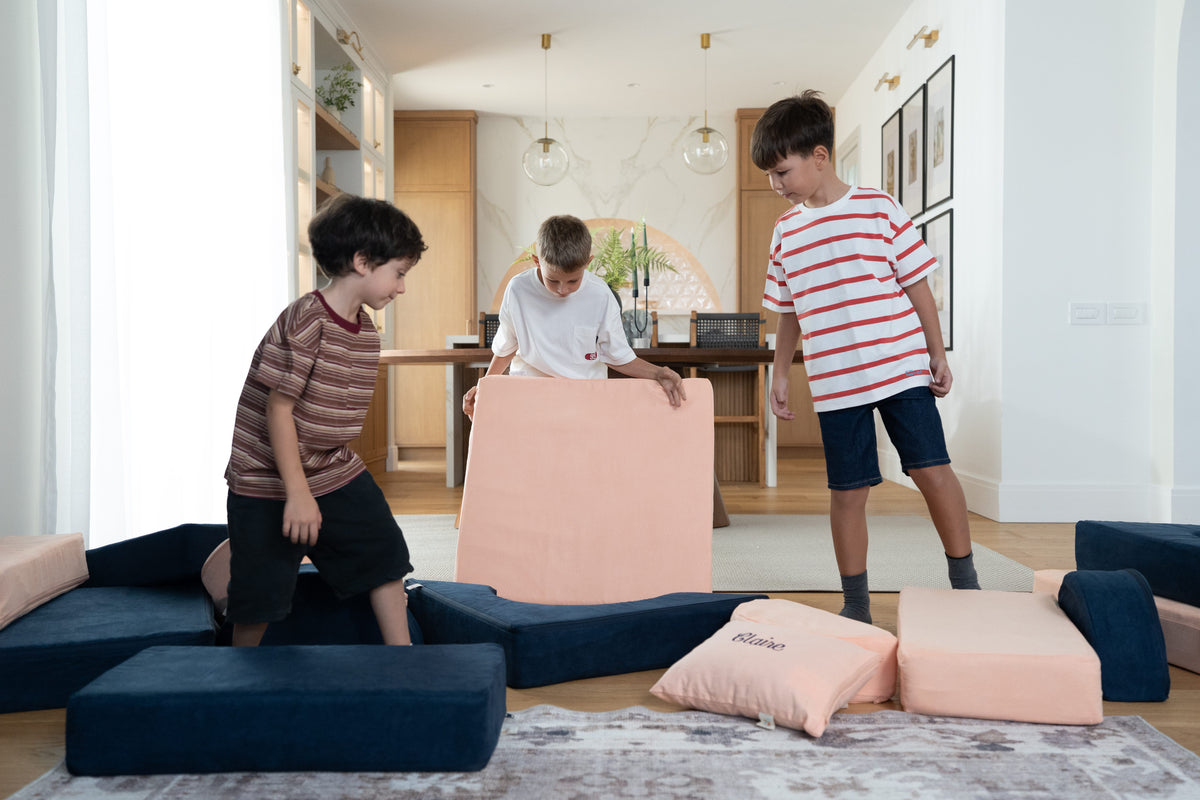
Here is how the same set of pieces changes over the years:
- Around 1 to 2: low climbing, Half-Moon “hills,” and a tunnel made from two Arches.
- Around 2 to 3: first forts with a blanket roof, a cozy den for a teddy, a car wash for toy trucks.
- Around 3 to 5: castles, rockets, shops and animal hospitals, often with a friend or sibling running the other half.
- 5 and up: big builds, obstacle courses they design themselves, and a comfy sofa for reading and movie night.
Run it through the five-question test and it scores a full five: many ways to play, the child does the work, still interesting a year later (and the year after that), siblings can join, and it mixes with everything from stuffed animals to toy cars.
The FoamOh Original Play Castle Sofa has 14 buildable pieces + 1 pillow: 4 Half-Moons, 2 Arches, 2 Triangle Wedges, 2 Squares and 4 Rectangles. The FoamOh Super Castle Play Sofa adds a Triangle Ramp, Steps and a Circle, for 17 buildable pieces + 1 pillow. Both use CertiPUR-US® certified foam, sofa-quality foam firm enough to climb and build on, with removable, machine-washable microsuede covers. FoamOh castles are for ages 1 and up.
Want to see what kids build? Browse our build inspiration page or the illustrated play couch builds. Not sure which castle to pick? Take the castle quiz.
Fewer toys, more play
More toys do not always mean more learning: a few good toys, rotated every week or two, often get deeper play than a full toy box. Toys that come back after a break feel new again. In one small study of toddlers, children played longer with each toy and in more ways when there were fewer toys in the room.
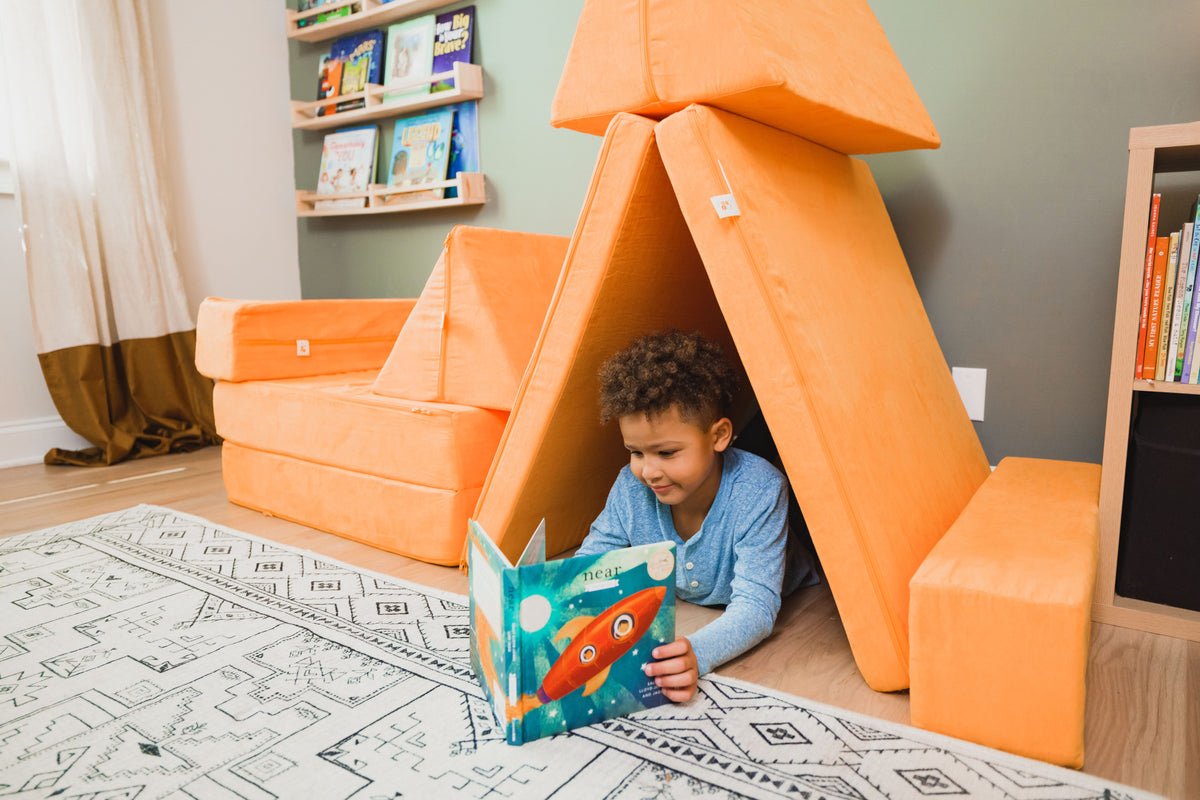
A simple rotation plan:
- Keep 6 to 10 toys out at a time.
- Store the rest in a closet or bin.
- Swap a few every week, keeping favorites out.
- Keep the “big” open-ended toys, like blocks and the play couch, out all the time.
Educational toys for toddlers: frequently asked questions
What are the best educational toys for toddlers?
The best educational toys for toddlers are simple and open-ended: blocks, chunky puzzles, play dough, balls, books, pretend play props and soft things to climb and build with, like a modular play couch. They let your child do the thinking, and they keep working as skills grow.
What are good educational toys for 2 year olds?
Good educational toys for 2 year olds include chunky blocks, knob puzzles, a ball to kick and throw, simple pretend props like a toy phone or a doll, board books, and something low and soft to climb on with supervision. Toys that use the whole body and invite pretending are a great fit at this age.
What are good educational toys for 3 year olds?
Good educational toys for 3 year olds include large beads to thread, play dough with simple tools, small jigsaw puzzles, dress-up clothes and pretend kits, crayons and paper, and building sets they can turn into anything. Three year olds love toys that support pretend stories and playing with friends.
Are electronic learning toys good for toddlers?
Electronic toys can be fun, but they are not needed for learning. A 2016 study in JAMA Pediatrics found that parents and babies talked less when playing with electronic toys than with traditional toys or books. The AAP encourages simple toys that get parents and children playing and talking together.
How many toys does a toddler need?
Fewer than you might think. A simple starting point is 6 to 10 toys out at a time, rotated every week or two. One small study found that toddlers played longer with each toy when fewer toys were out. Open-ended toys like blocks and soft building pieces can stay out all the time.
How do I know if a toy will grow with my child?
Ask five questions: can it be played with at least three ways, does my child do the work, will it still be interesting in a year, can a sibling or friend join in, and does it mix with other toys? A toy with three or more yeses is likely to last.
Buy for the kid they are becoming
The toys that teach the most are rarely the loudest ones in the store. They are the blocks that become a bakery, the play dough that becomes a snake and then a pizza, and the soft pieces that become a tunnel at 2 and a castle at 4. When you choose toys that grow, you buy fewer of them, your child plays longer with each one, and the toy graveyard finally gets a little smaller.
Browse FoamOh castles · Get build inspiration · Visit the FoamOh shop
FoamOh castles are designed for ages 1 and up, for imaginative play, not for sleeping. Always supervise children during play.
Written by Silvia Colaci, FoamOh
Updated November 13, 2026