


Independent play is when your child leads their own play, without an adult directing it or a screen entertaining them, while you stay close by. To encourage it, start small, set up a “yes space,” put out a few open-ended toys, play together for a moment and then step back. Even a few minutes counts at first.
You know the moment. You sit down with a warm cup of coffee, and within ten seconds a small person appears at your knee holding a sock and an expression of deep boredom. The tablet is right there. It would be so easy.
Here is the good news: independent play is a skill, not a personality trait. Some kids take to it faster than others, but most children can learn to play on their own for longer stretches with the right setup and a bit of patience. This guide covers why it matters, how much to expect at each age, eight ways to encourage it, and independent play ideas your toddler or preschooler can start today.
What independent play is, and what it is not
Independent play means your child leads the play while you stay close enough to see and hear them. They choose what to do, how to do it, and when to switch to something else. You are not the entertainment director.
It does not mean leaving a toddler alone in a room. Young children always need a grown-up nearby, especially during active play like climbing. Think of yourself as the lifeguard, not the swim coach. You are right there, you are paying attention, and you only jump in when you are needed.
It also is not the same as screen time. A show can keep a child still and quiet, but the show is doing the imagining. In independent play, your child is the one making things happen.
Why is independent play important?
Independent play gives children everyday practice at focusing, solving problems, being creative and handling small frustrations. These are things that are hard to teach directly:
- Focus. Staying with one activity, even for a few minutes, is real practice in paying attention.
- Problem solving. The tower falls. The blanket will not stay on the fort. Nobody fixes it for them, so they try again, differently.
- Creativity. With no one telling them what a cushion is for, it becomes a boat, a bus for a bear or a mountain.
- Handling frustration. Small struggles, with a grown-up nearby, show children that hard things can often be figured out.
- Confidence. “I made this” is a powerful feeling at any age.
The American Academy of Pediatrics report The Power of Play describes how play supports language, social skills, executive function and creativity. Independent play is one part of that bigger picture. Play together matters too. The goal is a healthy mix.
And yes, it matters for you. Ten minutes to cook dinner, answer an email or just sit is not selfish. It is how parents keep going.
Why screens make independent play harder
Screens are very good at filling quiet moments, and quiet moments are exactly where independent play begins. Screens are not evil, and most families use them. But boredom is often the starting line for a child’s best ideas.
Health guidance is fairly clear for young children:
- The AAP’s guidance on media and young minds suggests avoiding digital media for children younger than 18 to 24 months, other than video chatting, and limiting screen use to about one hour a day of high-quality programs for children ages 2 to 5.
- The World Health Organization’s guidelines for children under 5 do not recommend sedentary screen time for children under 2, and suggest no more than one hour a day for ages 2 to 4, with less being better.
You do not need to go screen-free overnight. A simple swap helps: keep screens out of the times you would most like your child to play on their own, like right after breakfast or while you make dinner.
How much independent play is realistic at each age?
Expect a few minutes at 1 and longer stretches as children grow, with every child moving at their own pace. There is no official number. Mood, sleep, hunger and the day’s excitement all play a part. Still, a realistic starting point helps, so you do not expect a 1 year old to play alone for an hour, or give up on a 4 year old after five minutes.
| Age | What it often looks like | A realistic place to start | Easy setup to try |
|---|---|---|---|
| 1 year | Exploring, emptying, filling, crawling in and out | A few minutes at a time, with you in the room | A basket of soft objects and a low tunnel to crawl through |
| 2 years | Climbing, moving things around, first pretend play | Around 5 to 10 minutes | A small den with a teddy and a few books inside |
| 3 years | Pretend stories, simple building, talking to themselves | Around 10 to 20 minutes | A fort with a “job”: a shop, a vet clinic, a rocket |
| 4 to 5 years | Bigger builds, longer stories, their own rules | 20 minutes or more on a good day | All the pieces and a challenge: “Build a house for every stuffed animal” |
These are rough starting points from everyday experience, not developmental rules. Some days will be longer, some much shorter, and that is normal. Always stay close enough to see and hear your child.
So, how much independent play for a 1 year old?
Think in minutes, not hours. At this age, a few minutes of happily emptying a basket while you sit nearby is a win. Short moments count, and they add up over a day. Babies and young toddlers check in often, by looking over, crawling back for a hug or handing you things. That is not failure. It is how they build the confidence to wander a little further next time.
How to encourage independent play: 8 things that actually help
Start together, make a yes space, offer fewer and more open-ended toys, and then step back.
1. Play together first, then step back
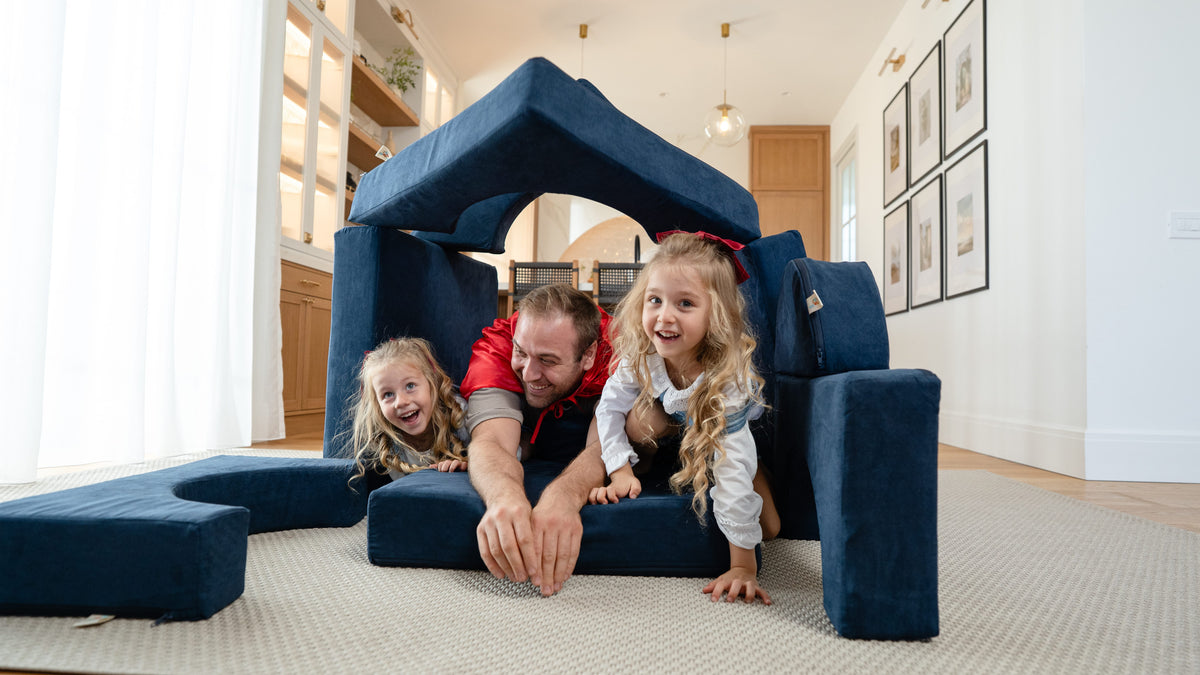
Children are much more likely to keep playing if you help them get started. Sit down for a few minutes, build the first wall of the fort, introduce the teddy who needs a house, then slowly lean back. “I am going to drink my tea right here. Tell me when the house is finished.”
2. Make a “yes space”
A yes space is an area where almost everything is okay to touch, so you are not saying “no” every thirty seconds: soft furniture, low toys, nothing breakable, nothing sharp. When kids can explore freely, they tend to stay longer.
3. Put out fewer toys
It sounds backward, but ten toys on the floor often get less play than three. Too many choices can lead to quick hopping from thing to thing. Keep a few out and rotate the rest every week or so. Old toys feel new again when they come back.
4. Choose open-ended toys
Toys that do one thing get one kind of play. Toys that can be anything get endless play. Blocks, play dough, scarves, cardboard boxes and soft building pieces all leave the imagining to your child.
5. Set up an invitation to play
An invitation to play is a small, simple setup waiting for your child to discover. A blanket half draped over a fort with a flashlight inside. Three stuffed animals sitting in a row like they are waiting for a show. You do not explain it. You just let them find it.
6. Do not rush to rescue
When the tower wobbles or the blanket slides off, count to ten before helping. Often your child will figure it out, and that small success is worth more than a perfect fort you built for them. If frustration turns into tears, of course step in. Then step back again.
7. Make it part of the day
Children like knowing what comes next. A regular time for independent play, like after breakfast or while dinner cooks, turns it from a surprise into a routine.
8. Let boredom happen
“I am bored” is not an emergency. It is often the moment right before a great idea. A calm “Hmm, I wonder what you will think of” works better than a list of suggestions.
Toddler independent play ideas, from 1 to 5
The best independent play ideas for toddlers are simple, physical and easy to repeat, and they grow into stories and bigger builds by age 4. These ideas use things you may already have, plus a few builds from a FoamOh castle: a set of soft foam pieces that stacks into a kid-sized sofa and comes apart for building. There is always something to climb, crawl through or turn into a story. Keep builds low, and always supervise.
Ages 1 to 2: simple, physical and repeatable
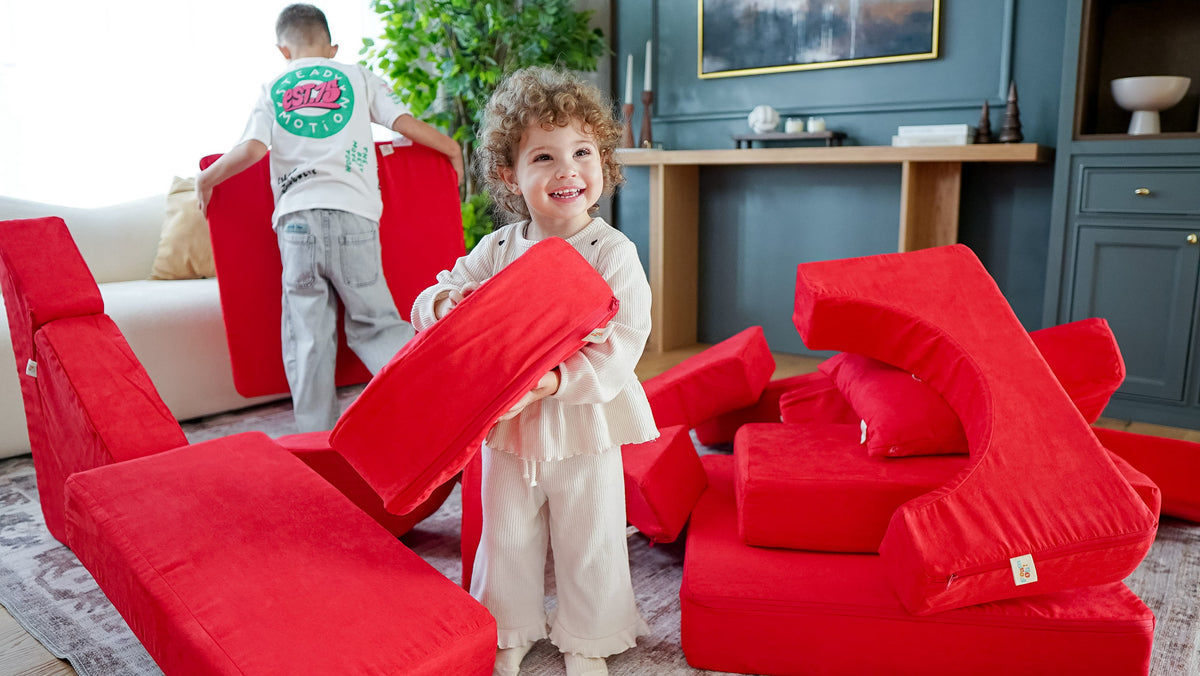
- The tunnel: two Arches in a row. Crawl in, crawl out, repeat about four hundred times.
- Hill country: Half-Moons in a line to climb over and slide down.
- Fill and dump: a basket of soft balls or large blocks to carry from one spot to another.
- Peekaboo den: a blanket over two Half-Moons. Hide a favorite toy inside for them to find.
Ages 2 to 3: first stories
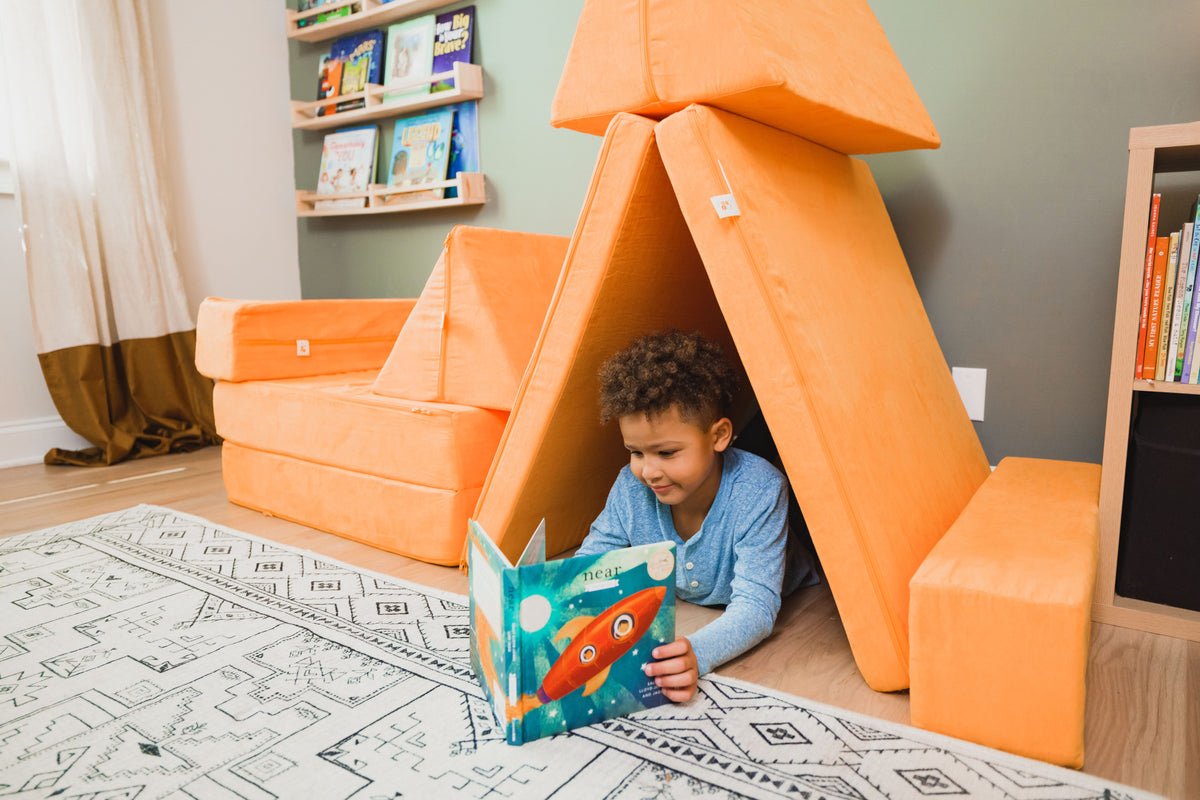
- Teddy’s house: a small fort with an Arch as the front door. Your child decides who lives there.
- The car wash: toy cars drive through the tunnel to get “washed.”
- Reading cave: a blanket roof, a pillow and a basket of board books inside.
- Stepping stones: Squares and Rectangles spread across the floor. The floor is lava, apparently.
Independent play for a 3 year old
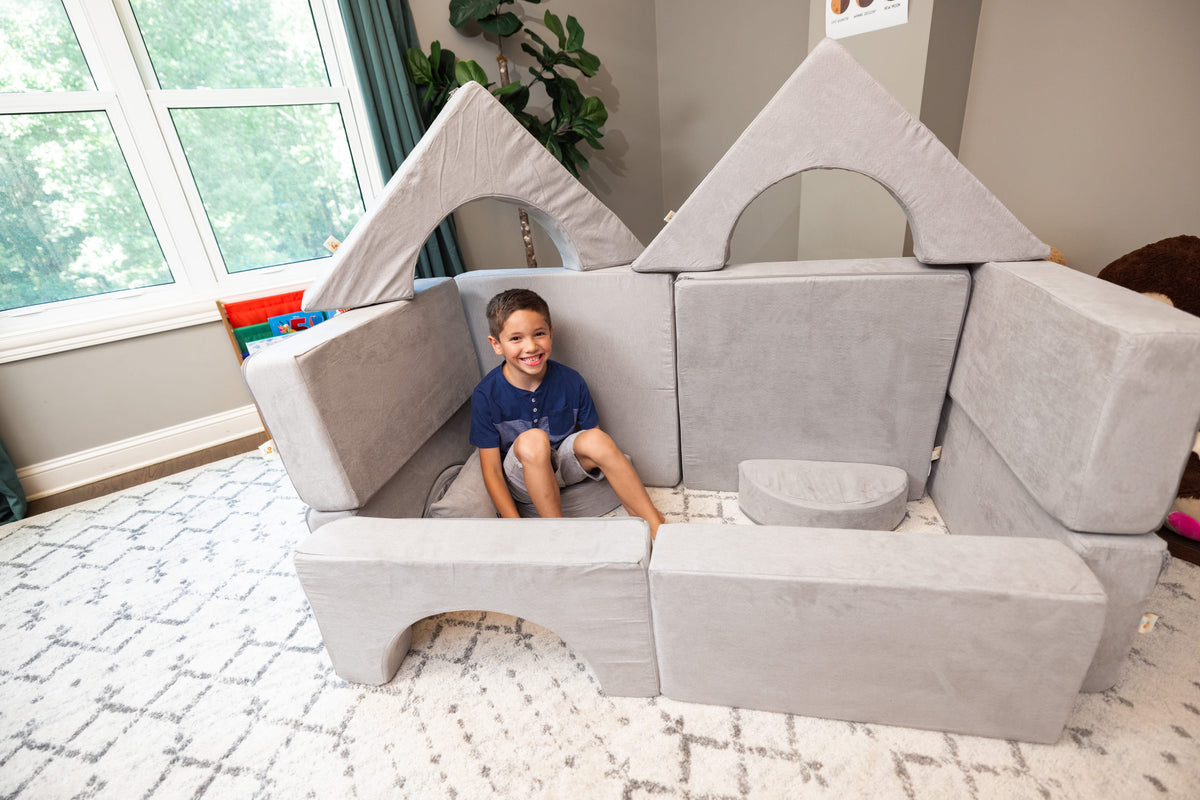
Three is when many children start to play on their own for real stretches, especially when the play has a role in it. Give the build a job and let them run it:
- The shop: Rectangles as the counter, pretend food on top, a “back room” behind an Arch.
- The vet clinic: a Rectangle as the exam table, stuffed animal patients waiting on the Half-Moons.
- The rocket: Half-Moons in a curve, a Rectangle as the control panel and a blanket overhead.
- The castle: Triangle Wedges as towers. A dragon (or a cat) is optional.
Ages 4 to 5: big builds and their own rules
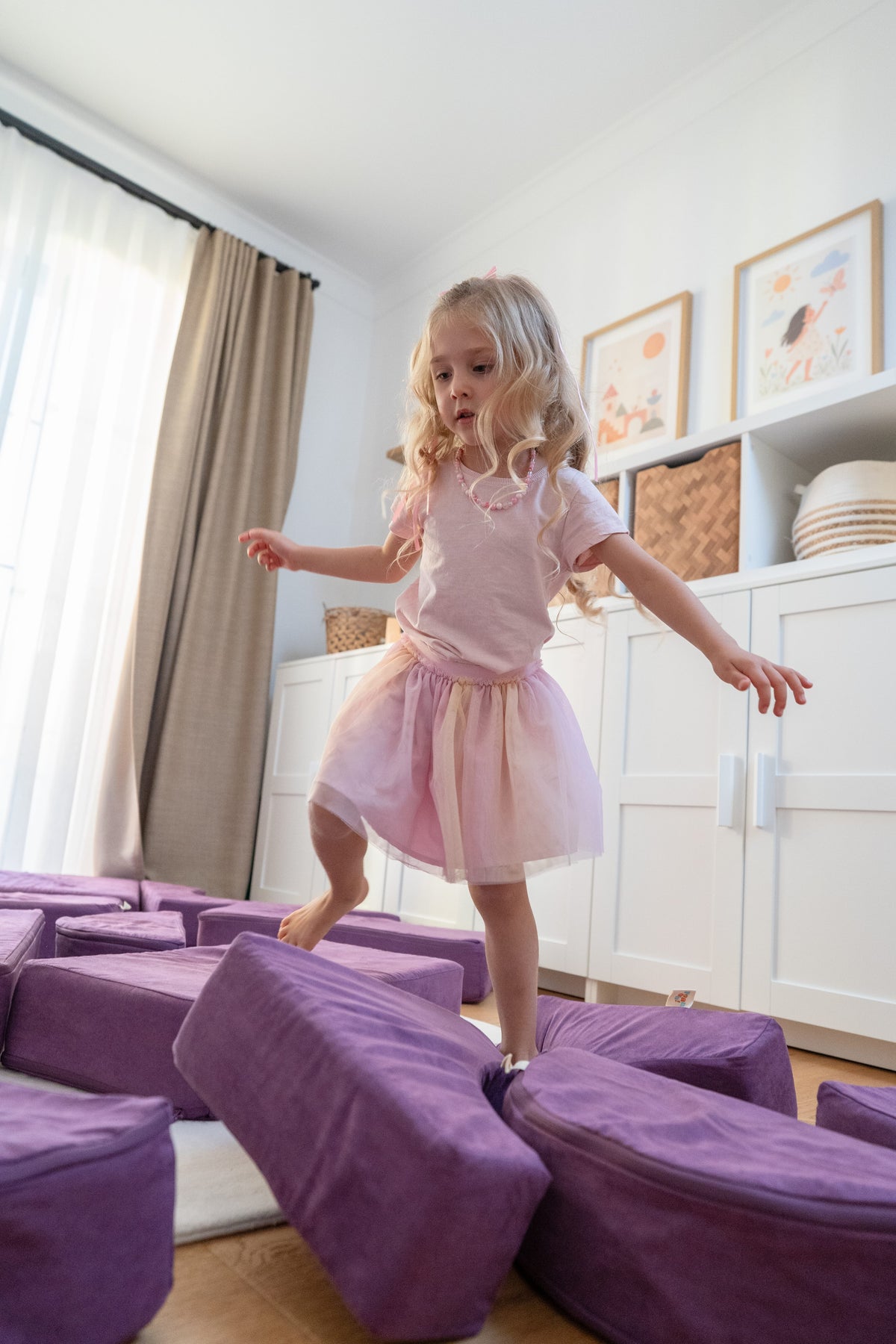
- The challenge build: “Can you make a house with two rooms?” or “Build a bridge your cars can drive under.”
- The obstacle course: they design it, they test it, they change it. With the FoamOh Super Castle Play Sofa, the Steps and Triangle Ramp make it even better.
- The show: a stage from flat Rectangles, an Arch as the backstage door and an audience of stuffed animals.
- The secret hideout: a fort with a “password” to get in. You may be asked for it.
For dozens more ideas, see our build inspiration page and our illustrated play couch builds.
When it is just not working
Clingy days are normal, and they usually have a simple cause. Some days your child will not leave your side, and that is okay. A few common reasons:
- Big changes. A new sibling, a move, a new daycare or a sick week can make kids extra clingy for a while. Lots of together time first usually helps.
- Hunger or tiredness. Independent play goes better after a snack and a good nap.
- Too much on the floor. Pack half of it away and try again tomorrow.
- It is new. If your child is used to you leading every game, expect a few days of “come play with me!” before they settle in. Keep the routine going.
Progress is rarely a straight line. If yesterday was twenty minutes and today is three, that is still progress overall.
Why a play couch helps
A good independent play space has something to move on, something to hide in and something to pretend with, and a modular play couch covers all three. When playtime is over, it goes back to being a sofa.
The FoamOh Original Play Castle Sofa has 14 buildable pieces + 1 pillow: 4 Half-Moons, 2 Arches, 2 Triangle Wedges, 2 Squares and 4 Rectangles. The FoamOh Super Castle Play Sofa adds a Triangle Ramp, Steps and a Circle, for 17 buildable pieces + 1 pillow. Both use CertiPUR-US® certified foam that is firm enough to climb and build on, with removable, machine-washable microsuede covers. Compare the castles here, or take the castle quiz.
Independent play: frequently asked questions
Why is independent play important?
Independent play gives children practice at focusing, solving problems, handling small frustrations and coming up with their own ideas. It can also build confidence, because the child is the one making things happen. It works best alongside plenty of play together with parents and other kids.
How much independent play should a 1 year old have?
There is no official amount. At around 1 year, a few minutes at a time is a realistic start, with a grown-up in the same room. Short stretches throughout the day add up. Expect lots of check-ins, which are a normal part of learning to play alone.
How do I get my 3 year old to play independently?
Start by playing together for a few minutes, then step back while staying nearby. Offer a few open-ended toys instead of many, give the play a role, like a shop or a rocket, and keep a regular time each day for it. Once it becomes a routine, some 3 year olds play on their own for 10 to 20 minutes.
What are good toddler independent play ideas?
Good toddler independent play ideas include crawling through a soft tunnel, climbing over low foam hills, filling and dumping a basket of soft objects, a small den with a teddy inside, and a reading nook with board books. Simple, repeatable activities work best for toddlers.
Is independent play the same as leaving my child alone?
No. Independent play means your child leads the play, not that they are unsupervised. Stay close enough to see and hear them, especially during climbing and active play, and step in when they need you.
What can replace screen time for toddlers?
Open-ended, hands-on play is a great replacement for screen time: building forts, crawling through tunnels, simple pretend play, books, play dough and outdoor time. Setting up a small invitation to play, like a blanket fort with a flashlight inside, can make the switch easier.
Small minutes, big skills
Independent play does not start with an hour of quiet. It starts with three minutes in a tunnel, then five with a teddy in a fort, then twenty running a very busy shop. Each little stretch is your child finding out that they can make their own fun, and that is a skill worth building.
So put the tablet in a drawer for an afternoon, build the first wall together, and then sit back with that coffee. It might even still be warm.
Browse FoamOh castles · Get build inspiration · Visit the FoamOh shop
FoamOh castles are designed for ages 1 and up, for imaginative play, not for sleeping. Always supervise children during play.
Written by Silvia Colaci, FoamOh
Updated November 13, 2026